Seven women, ₹80 and one rooftop: the Lijjat Papad story
In 1959 seven women in Mumbai borrowed ₹80 and made four packets of papad on a terrace. Lijjat now has about 45,000 women members who co-own it.
Lijjat Papad's annual turnover is reported at more than ₹1,600 crore. Seven women in Girgaum, Mumbai, started it on 15 March 1959 with ₹80 borrowed money, and about 45,000 women now co-own it.

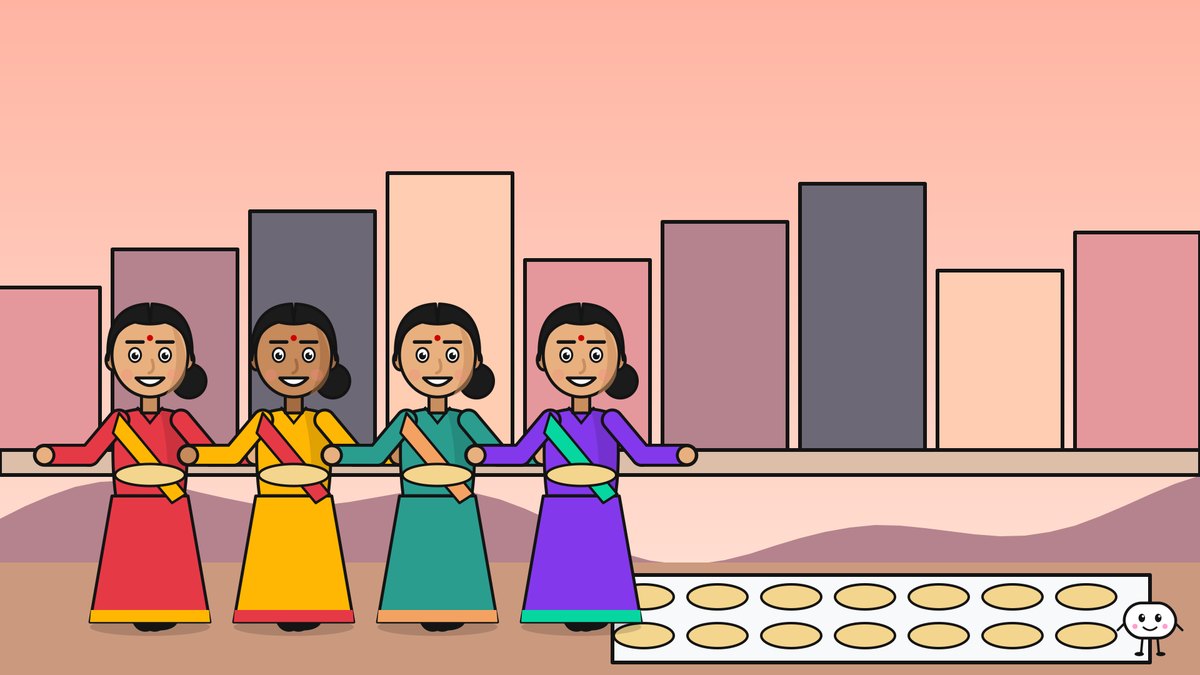
Illustration: women rolling papad on a city rooftop terrace, with papad drying on a white cloth.
In this story
On 15 March 1959, on the terrace of a residential building in Girgaum, in south Mumbai, seven women rolled out their first batch of papad. It came to four packets, and they sold them to a local shopkeeper.
The money to buy the flour and spices was a loan of ₹80. More than six decades later, the organisation those women started is reported to have a turnover of about ₹1,600 crore and around 45,000 women members, every one of them a co-owner.
Who started Lijjat Papad?
The founders were seven neighbours, Gujarati-speaking housewives with little formal education, who wanted to earn money of their own. The best known of them is Jaswantiben Jamnadas Popat. "We were semi-literate, which restricted our chances to get jobs," she told The Better India.
What they did have was a skill. Papad, the thin, crisp lentil wafer served with Indian meals, was something they already made well at home. "Making papads does not require education, which is why we started Lijjat," Jaswantiben said in an interview quoted by Business Insider India.
The ₹80 loan and the first day
The ₹80 came from Chhaganlal Karamsi Parekh, a social worker in the area known as Chhagan Bappa, who became the group's mentor. According to the World Intellectual Property Organization (WIPO), he also helped shape the principles that guided it, including running it in a professional way and standing on its own feet rather than depending on donations.
The first sales were tiny. Jaswantiben recalled that on the first day they sold one kilo of papad and earned eight annas, half a rupee, and the next day two kilos brought in one rupee. Sales for the whole first year came to just over ₹6,000, according to The Better India and YourStory.
Early problems were practical ones. WIPO notes that the women first dried papad over charcoal, which left the wafers dirty, so within about a year they bought a covered stove. Not every step worked: an attempt to open a branch in Malad in 1961 failed. They learned from it and kept going.
How the Lijjat cooperative model works
Word spread among women in the neighbourhood, and within months dozens had joined. From the start, the group made a choice that shaped everything: women who join are not employees. They are members, known as 'sisters', who together own the organisation and share in its earnings.
In 1962 the group picked the brand name Lijjat, a Gujarati word for tasty, through a small prize contest among members. By 1962-63, annual sales had grown to close to ₹2 lakh. In 1966 it registered as a society, and the Khadi and Village Industries Commission recognised it as a village industry, which opened up better access to finance. In 1968 it opened its first branch outside Maharashtra, at Valod in Gujarat.
WIPO describes the work as split into processing, packaging and distribution, coordinated by a central managing committee in Mumbai, with branches that run themselves but follow the same rules. Members earn a wage for rolling, called vanai, and Business Insider India reports that a 21-member committee decides how profits are shared.
Why Lijjat's quality stayed the same
A brand made in thousands of homes could easily taste different from one packet to the next. Lijjat's answer was strict standardisation. The Better India reports that raw materials are bought from a single source and sent to all branches, each member gets a standard base and rolling pin so papads come out the same size, and finished products are tested in a laboratory in Mumbai.
WIPO's case study adds that daily samples are checked and substandard batches are destroyed. The organisation has also chosen to keep production by hand rather than move to mass machine production, so that the work stays with women members.
How big is Lijjat Papad today?
The numbers kept compounding. Recent reports by Business Insider India, The Better India and YourStory put Lijjat's turnover at about ₹1,600 crore and its membership at around 45,000 women. Reports give its branch count as 81 or 82, and it exports papad to countries including the United States, the United Kingdom and Singapore.
Lijjat has also expanded beyond papad into products such as spices, wheat flour and the Sasa range of detergents, which it launched in 1988. WIPO also notes that it runs scholarships and education grants for members and their families, especially daughters.
In 2021 Jaswantiben Popat, then 91, received the Padma Shri, one of India's highest civilian honours. "The credit of Lijjat Papad goes to every woman working here," she said afterwards.
What the Lijjat story shows about starting small
The founders did not wait for a factory, an investor or a business plan. They started with a skill they already had, a loan small enough to repay and a product they could make the next morning.
The capital was the least important part. What mattered was showing up every day, holding the quality steady, and building a structure where every new member had a real stake in the result.
It also shows how structure can protect a habit. Because members own the work, the standards set on that first terrace, careful quality and steady daily effort, travelled with Lijjat into every new branch.
The money behind it
By Manisha Aggarwal, accounting professional
As an accountant, the number I keep coming back to is the ₹80. Adjusted for India's consumer price inflation, it is worth roughly ₹7,400 in today's money. That is less than many people spend on a phone. It was never the capital that built Lijjat.
What built it was compounding. Sales in the first year were just over ₹6,000. Reports now put turnover at about ₹1,600 crore. That is roughly 27 lakh times larger, which works out to sales growing about 26% a year, every year, for more than six decades. Even after removing inflation, real growth was about 18% a year. Very few Indian businesses of any kind have sustained that for so long.
One caution when reading these figures: ₹1,600 crore is turnover, not profit, and it is shared across about 45,000 members. That is roughly ₹3.6 lakh of sales per member each year, before the cost of flour, spices and packing. Lijjat's real achievement is not one big number. It is thousands of steady, modest earnings that the women own outright.
| The 1959 loan of ₹80, in today's money | about ₹7,400 |
|---|---|
| First-year sales (just over ₹6,000), in today's money | about ₹5.5 lakh |
| Sales in 1962-63 (close to ₹2 lakh), in today's money | about ₹1.7 crore |
| Growth from first-year sales to ₹1,600 crore | about 26% a year (about 18% after inflation) |
| Turnover per member (₹1,600 crore ÷ 45,000) | about ₹3.6 lakh a year |
How we calculated this: inflation uses India's consumer price index from the World Bank (series FP.CPI.TOTL, 1960 to 2025; 1960 is the earliest year available, so it stands in for 1959). Growth rates are compound annual rates from first-year sales (1959-60) to the ₹1,600 crore turnover reported in 2023. Figures are rounded. General education, not financial advice.
Try it yourself: inflation calculator · growth-rate (CAGR) calculator
Timeline
- 1959Seven women borrow ₹80 and make four packets of papad on a Girgaum terrace (15 March)
- 1962The brand name Lijjat is chosen through a members' contest
- 1966Registers as a society; recognised as a village industry by KVIC
- 1968Opens its first branch outside Maharashtra, at Valod in Gujarat
- 1988Launches Sasa detergents
- 2021Co-founder Jaswantiben Jamnadas Popat receives the Padma Shri at 91
You don't need big money to start something. You need a skill, a small first step and people who keep showing up, with a stake in what they build.
Your check
- What is the ₹80 version of your idea: the smallest test you could run this month?
- Who are the two or three people who would show up for it every day, and what would they own?
Questions people ask
How did Lijjat Papad start?
On 15 March 1959, seven women in Girgaum, south Mumbai, borrowed ₹80 from social worker Chhaganlal Karamsi Parekh to buy ingredients. They made four packets of papad on their building's terrace and sold them to a local shop.
Who founded Lijjat Papad?
Seven Gujarati-speaking women from the same neighbourhood founded it. The best known is Jaswantiben Jamnadas Popat, who received the Padma Shri in 2021.
How many women work at Lijjat Papad?
Recent reports put membership at around 45,000 women. They are co-owners, called 'sisters', rather than employees.
What is Lijjat Papad's turnover in 2026?
The most recent reports put Lijjat's annual turnover at more than ₹1,600 crore. Impact on Net (September 2026) cites industry estimates of "upward of Rs 1,600 crore", in line with the figure reported earlier by Business Insider India, The Better India and YourStory.
What does Lijjat mean?
Lijjat is a Gujarati word meaning tasty. The name was chosen in 1962 through a small prize contest among the members.
Sources
- WIPO IP Advantage: Pappadums and the Path to Empowerment (updated 24 Jul 2013)
- Business Insider India: The 91-year-old woman behind India's most famous papad brand gets the Padma Shri (Nov 2021)
- The Better India: Lijjat Papad, women empowerment and an inspiring history (14 Jul 2020)
- YourStory: From Rs 80 to Rs 1,600 crores, the Lijjat Papad success story (16 Oct 2023)
- World Bank: Empowering women in urban India, Shri Mahila Griha Udyog Lijjat Papad (case study)
- Impact on Net (1 Sep 2026): Roots to legacy, six decades of Lijjat profit and female ownership
Every fact on this page comes from the sources above, and every number is checked in at least two. General education, not personal or financial advice. Spotted an error? Tell us and we will correct it. Read our editorial standards.