Seven Investors Said No to Airbnb: The $150,000 Offer Nobody Took, and What Happened Next
In 2008 Airbnb's founders offered 10% of the company for $150,000. Of seven investors, five said no and two never replied. The true story and the lesson.
How many investors rejected Airbnb?
Seven investors were introduced to Airbnb's founders in June 2008. Five replied with a no and two never replied. Brian Chesky later published the emails under the title "7 Rejections".

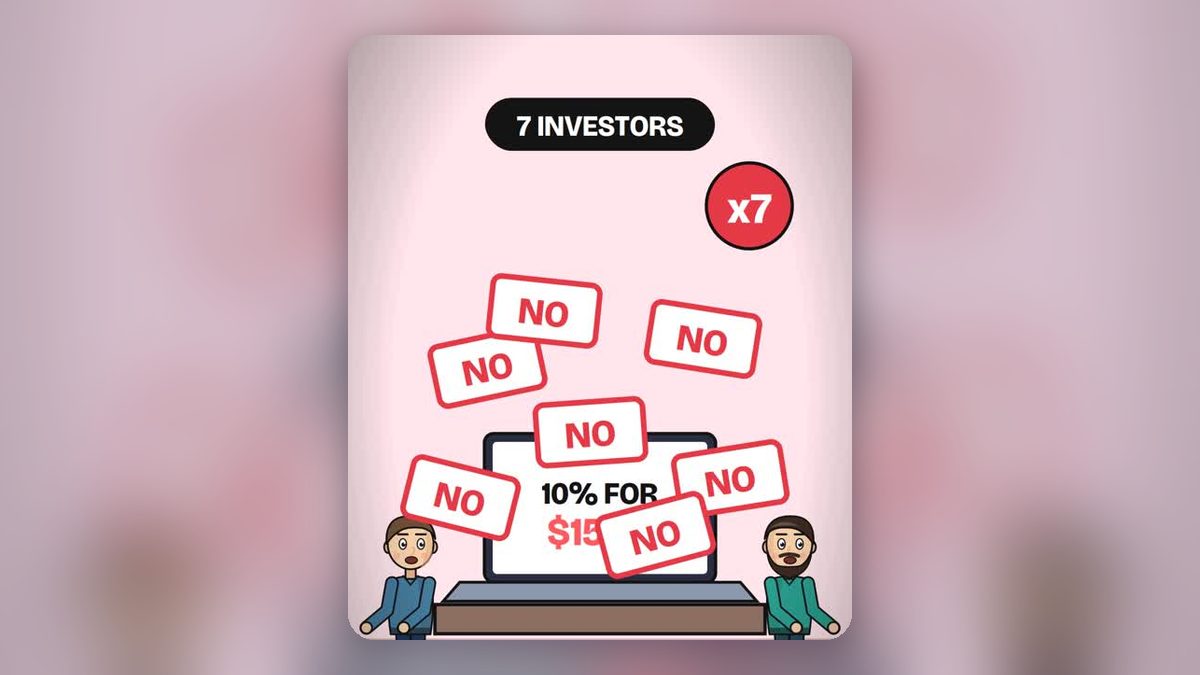
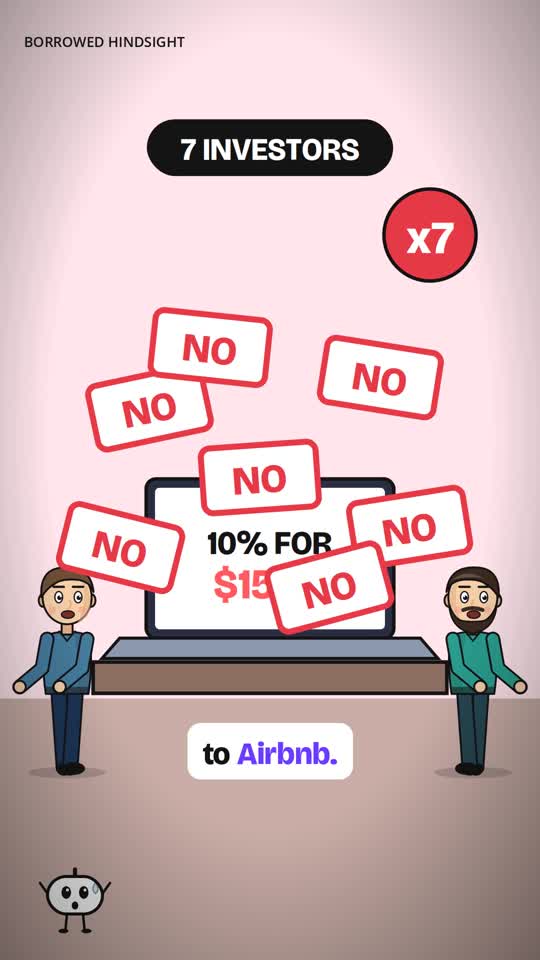
Illustration from the Borrowed Hindsight video about this story.
In this story
In the summer of 2008, three young founders in San Francisco tried to sell 10% of their company for $150,000. They were introduced to seven investors. Five wrote back to say no. The other two never replied.
The company was Airbnb. Twelve years later, on its first day as a public company, it was worth more than $80 billion. This is what happened in between, and what the rejections really tell us.
How did Airbnb start?
In 2007 Brian Chesky and Joe Gebbia, two designers who had studied together at the Rhode Island School of Design, were sharing an apartment in San Francisco and struggling to pay the rent. A big design conference was coming to town and the city's hotels were full.
So they laid air mattresses on their floor and offered visitors a place to sleep plus breakfast in the morning. Their first guests each paid $80. A third former roommate, the engineer Nathan Blecharczyk, joined to build the website, and the idea got a name: Air Bed and Breakfast.
It was a tiny, scrappy start. The founders did not have a grand plan for a global company. They had a rent problem and an empty floor.
Who rejected Airbnb, and what did they say?
In June 2008 the founders were trying to raise $150,000 at a valuation of $1.5 million, which means the money would have bought 10% of the company. They were introduced to seven well-known investors in Silicon Valley.
In 2015 Brian Chesky published the rejection emails on Medium under the title "7 Rejections", with the investors' names removed. Five investors replied and said no. The reasons were polite and short: the idea was outside the firm's focus, the firm was not keen on travel businesses, or the market opportunity did not seem large enough. Two investors did not reply at all.
Chesky counted all seven as rejections, and that is how the story is usually told. The more precise version is five written noes and two silences, which, to a founder waiting for an answer, feel much the same.
Why did investors doubt Airbnb?
Today it sounds obvious that people will rent a room or a whole home from a stranger. In 2008 it sounded odd, even risky. Many investors simply did not believe that strangers would want to sleep in each other's homes, or that enough people would do it to build a large business.
That doubt is worth remembering. An idea that is new often looks wrong at first, because there is nothing to compare it with. The investors were not foolish. They were judging an unusual idea, with little data, on one day.
It also helps to remember what a rejection email usually is: a short, polite answer from a busy person who sees many pitches every week. It is rarely a careful verdict on whether your idea can work.
How did cereal boxes keep Airbnb alive?
By late 2008 the founders were broke and in debt. During a big convention in Denver, when visitors again needed places to stay, they designed their own limited-edition cereal boxes and sold them for $40 each. According to the founders, the boxes brought in about $30,000.
The money mattered, but the boxes did something more. When the founders interviewed for the start-up programme Y Combinator, its co-founder Paul Graham was struck by how hard they had worked to keep going. Airbnb joined the programme in early 2009, renamed itself Airbnb in March 2009, and in April 2009 received a $600,000 seed investment from Sequoia Capital.
How big did Airbnb become?
Airbnb listed its shares on the stock market on 10 December 2020. The shares were priced at $68 and closed their first day at $144.71, more than double. At that closing price the company was valued at about $86.5 billion, according to CNBC.
Put next to the 2008 offer, the gap is huge. Ten percent of the company for $150,000 would have been worth billions on paper at that moment, before any later dilution. That is why the rejection emails became famous: they are a rare, written record of a "no" that turned out to be wrong.
Myth vs fact: what the Airbnb rejections really teach
Myth: the investors who said no were bad at their jobs. Fact: experienced investors say no to most pitches, and most of those noes are right. The lesson is not that experts are always wrong, but that a single no is one person's view of your idea on one day, with the information they had then.
Myth: Airbnb succeeded because someone finally believed in it. Fact: the founders kept going before anyone believed in it. They kept hosting, kept improving the site and found money in unusual ways, so that when the next person looked, there was more to see.
If you have had a no recently, the useful question is not "were they right?" but "what would make the next person say yes?" Then send it to someone new.
The money behind it
By Manisha Aggarwal, accounting professional
In 2008 the founders asked for $150,000 for 10% of the company, which valued Airbnb at $1.5 million. In today's dollars that is about $220,000 for a tenth of the business. Seven investors said no.
At its first close as a public company in 2020, Airbnb was worth about $86.5 billion, roughly 58,000 times that 2008 valuation. As an accountant I would add one caution: early shares get diluted by every later funding round, so a 10% stake would have shrunk well before 2020. It would still have been worth billions.
| Asking price in 2008: $150,000 for 10% | about $220,000 today |
|---|---|
| Valuation implied in 2008 | $1.5 million |
| Value at first close as a public company (2020) | about $86.5 billion |
| Cereal-box sales that kept them going | about $30,000 (about $44,000 today) |
Dollar inflation uses the US consumer price index from the World Bank (series FP.CPI.TOTL, to 2024, the latest year available). Figures are rounded. General education, not financial advice.
Try it yourself: inflation calculator · growth-rate (CAGR) calculator
Timeline
- 2007Brian Chesky and Joe Gebbia rent air mattresses in their San Francisco apartment during a design conference; first guests pay $80 each
- 2008Nathan Blecharczyk joins; the site launches as Air Bed and Breakfast
- June 2008Raising $150,000 for 10% at a $1.5 million valuation; of seven investors introduced, five say no and two do not reply
- Late 2008The founders sell limited-edition cereal boxes at $40 each, raising about $30,000
- Early 2009Airbnb joins Y Combinator; renamed Airbnb in March 2009
- April 2009$600,000 seed investment from Sequoia Capital
- July 2015Brian Chesky publishes the rejection emails as "7 Rejections"
- 10 December 2020First day of trading: shares close at $144.71, valuing Airbnb at about $86.5 billion
A no is one opinion, on one day. Improve what you can, then pitch someone new.
Your check
- What is one idea, email or application that got a no, and who is one new person you could send it to this week?
Questions people ask
How many investors rejected Airbnb?
Seven investors were introduced to Airbnb's founders in June 2008. Five replied with a no and two never replied. Brian Chesky later published the emails under the title "7 Rejections".
How much did Airbnb ask investors for in 2008?
$150,000 at a valuation of $1.5 million, which would have bought 10% of the company.
Why did investors reject Airbnb?
Many doubted that strangers would want to stay in each other's homes, or that the market was big enough. Some said the idea did not fit what they invested in.
What was the Airbnb cereal box story?
In 2008, short of money, the founders designed limited-edition cereal boxes and sold them for $40 each, raising about $30,000. The story also impressed Y Combinator's Paul Graham.
How much was Airbnb worth at its IPO?
On its first day of trading, 10 December 2020, Airbnb shares closed at $144.71, valuing the company at about $86.5 billion (CNBC).
Sources
- Brian Chesky, "7 Rejections", Medium, July 2015
- Airbnb once tried to give away 10% of the company for $150K and nobody bit, VentureBeat, 13 Jul 2015
- How 3 guys turned renting an air mattress in their apartment into a $25 billion company, Business Insider
- Airbnb CEO says his company was rejected by investors until a $40 box of cereal turned things around, CNBC, 18 Apr 2023
- Airbnb skyrockets 112% in public market debut, giving it a market cap of $86.5 billion, CNBC, 10 Dec 2020
- Who started Airbnb?, Fox Business
- How the founders of Airbnb went from cash-strapped roommates to billionaires, The Peak Magazine
Every fact on this page comes from the sources above, and every number is checked in at least two. General education, not personal or financial advice. Spotted an error? Tell us and we will correct it. Read our editorial standards.