Alex Honnold: 3,000 Feet, No Rope, and the Year of Practice Nobody Saw
Alex Honnold climbed El Capitan with no rope in 3 h 56 min in 2017. His first try ended in under an hour. Here is the practice behind it.
How long did it take Alex Honnold to climb El Capitan without a rope?
3 hours and 56 minutes. He started at 5:32 a.m. and reached the top at 9:28 a.m. on 3 June 2017, according to NPR and National Geographic.

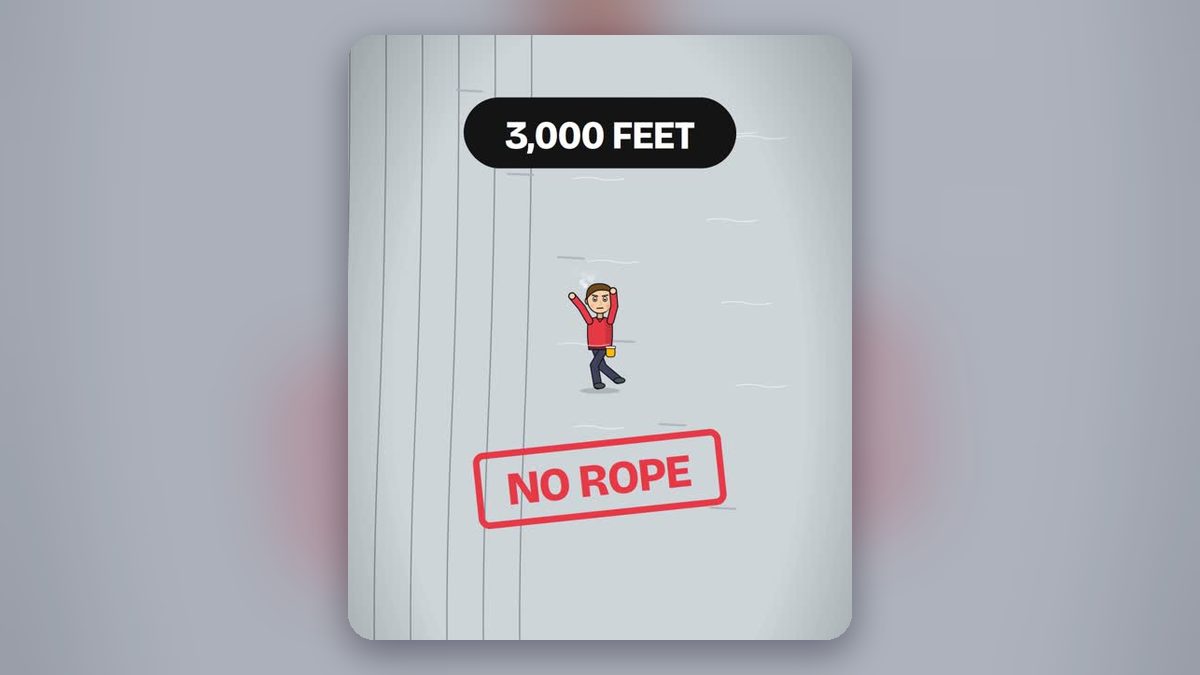
Illustration from the Borrowed Hindsight video about this story.
In this story
- Who is Alex Honnold?
- What is a free solo, and what makes El Capitan different?
- Did Alex Honnold fail his first attempt on El Capitan?
- How did Alex Honnold prepare for the El Capitan free solo?
- What happened on 3 June 2017?
- What did Alex Honnold do after El Capitan?
- Myth vs fact: was it fearlessness?
- Timeline
- The borrowed hindsight
- Questions people ask
- Sources
At 5:32 in the morning on 3 June 2017, Alex Honnold started up a granite wall in Yosemite National Park with no rope, no harness and no partner. At 9:28 he stood on top. Three hours and fifty-six minutes for a wall of nearly 3,000 feet: the first free solo of El Capitan, a climb Alpinist magazine called the greatest free solo of all time.
What looks like pure nerve was something else. His first attempt, the previous November, ended in less than an hour. What happened between that turn-back and the summit is the useful part of the story.
Who is Alex Honnold?
Alex Honnold was born on 17 August 1985 in Sacramento, California. He started climbing in a gym as a child and was soon climbing several times a week. He enrolled at the University of California, Berkeley, to study civil engineering, then left to climb full time.
For years he lived out of a van, driving between climbing areas. In 2008 he made his name with two ropeless climbs that shocked the climbing world: Moonlight Buttress in Utah and the Regular Northwest Face of Half Dome in Yosemite. Both were huge walls that very few people would attempt even with a rope.
What is a free solo, and what makes El Capitan different?
In a free solo the climber uses only hands and feet, with no rope, harness or protective gear. Every move has to be right. Most climbers, even world-class ones, never free solo anything big.
El Capitan is a different scale. National Geographic describes the wall as nearly 3,000 feet tall, more than half a mile of granite; Guinness World Records lists it at 2,900 feet. Honnold chose Freerider, a 30-pitch route that includes sections of smooth, glassy rock. He told National Geographic that parts of it felt "like walking up glass." He had been thinking about a ropeless ascent for years before he committed to it.
Did Alex Honnold fail his first attempt on El Capitan?
Yes, in a sense. In November 2016 he set off on his first attempt and backed off in less than an hour because conditions did not feel right, according to National Geographic. He climbed down, went home and kept training.
That decision matters more than it first appears. The person famous for having no fear was the same person who turned around when something felt wrong. Turning back was not the end of the plan. It was part of it.
How did Alex Honnold prepare for the El Capitan free solo?
National Geographic reports that he trained for more than a year, on rock in the United States, China, Europe and Morocco. He rehearsed the hand and foot sequences of the hardest pitches again and again with a rope, until each move was automatic. He did long fingertip hangs and pull-ups on a training rig bolted inside his van, and he logged his workouts in a journal.
Over Memorial Day weekend in 2017, a week before the real climb, he made a practice run of Freerider with his friend Tommy Caldwell, roped up, in just over five and a half hours. Days before the ascent he rappelled down the route to check that the chalk marks he relied on had survived a rainstorm. By the morning of 3 June, nothing on the wall was new to him.
What happened on 3 June 2017?
He started at 5:32 a.m. and topped out at 9:28 a.m. Pacific time, 3 hours and 56 minutes for the whole wall, as reported by NPR and National Geographic. Guinness World Records lists it as the first free solo climb of El Capitan. On Facebook that day he wrote that he was "so stoked to realize a life dream," NPR reported.
The climb was filmed by Jimmy Chin and Elizabeth Chai Vasarhelyi. Their documentary, Free Solo, won the Academy Award for Best Documentary Feature in February 2019, which is how millions of people who have never touched a climbing wall first heard his name.
What did Alex Honnold do after El Capitan?
He kept using the same method: rehearse, fail, adjust, try again. In June 2018, just a year after the free solo, he and Tommy Caldwell climbed The Nose, the most famous route on El Capitan, with ropes this time, in 1 hour, 58 minutes and 7 seconds. Caldwell wrote in the American Alpine Journal that they managed it after 11 previous attempts. It was the first time anyone had climbed the route in under two hours.
Away from the rock, he set up the Honnold Foundation in 2012, years before he was famous outside climbing. It focuses on solar energy, helping communities get access to clean power. The climber people call fearless spends much of his time on something slow and patient.
Myth vs fact: was it fearlessness?
Myth: Honnold climbed El Capitan because he simply does not feel fear. Fact: the record shows a man who abandoned his first attempt in under an hour, spent more than a year rehearsing, wrote down his training and checked his chalk marks after rain. National Geographic quotes him saying fear was "only hindering my performance," so he set it aside. He did that after the preparation, not instead of it.
That is the borrowed hindsight. What strangers call fearless is usually practice they never saw. If something big scares you, the useful question is not "am I brave enough?" but "what can I rehearse until it is ordinary?" And turning back on a bad day is not failure. It can be the first step of the plan that works.
Timeline
- 1985Born on 17 August in Sacramento, California
- 2008Free solos Moonlight Buttress (Utah) and Half Dome's Regular Northwest Face (Yosemite)
- 2012Founds the Honnold Foundation, focused on solar energy
- Nov 2016First attempt to free solo El Capitan; backs off in less than an hour
- 2016-2017More than a year of training; rehearses Freerider's hardest moves on a rope
- 3 Jun 2017Free solos El Capitan via Freerider in 3 hours 56 minutes, a first
- Jun 2018With Tommy Caldwell, climbs The Nose on El Capitan in 1:58:07, the first time under two hours
- Feb 2019Free Solo wins the Academy Award for Best Documentary Feature
Fearless is just practice nobody saw. Rehearse the scary thing until it is ordinary, and treat turning back on a bad day as part of the plan.
Your check
- What is one thing you avoid because it scares you, and what could you practise for a month to make it ordinary?
Questions people ask
How long did it take Alex Honnold to climb El Capitan without a rope?
3 hours and 56 minutes. He started at 5:32 a.m. and reached the top at 9:28 a.m. on 3 June 2017, according to NPR and National Geographic.
How tall is El Capitan?
National Geographic describes the wall as nearly 3,000 feet (over half a mile); Guinness World Records gives 2,900 feet (884 m).
Which route did Alex Honnold free solo on El Capitan?
Freerider, a 30-pitch route on the wall, according to National Geographic.
Did Alex Honnold fail before climbing El Capitan?
He made a first attempt in November 2016 and backed off in less than an hour because conditions did not feel right, National Geographic reports. He kept training and succeeded the following June.
Did Free Solo win an Oscar?
Yes. Free Solo, directed by Jimmy Chin and Elizabeth Chai Vasarhelyi, won the Academy Award for Best Documentary Feature in February 2019.
Sources
- The most dangerous free solo climb: Alex Honnold on El Capitan, National Geographic
- Alex Honnold scales El Capitan without ropes, NPR via MPR News, 6 Jun 2017
- First free solo climb of El Capitan, Guinness World Records
- Alex Honnold, Encyclopaedia Britannica
- Six amazing first free solos by Alex Honnold, Gripped
- 'Free Solo' wins 2019 Oscar for Best Documentary, Sports Illustrated, 24 Feb 2019
- The Nose Under Two Hours, Tommy Caldwell, American Alpine Journal 2019
- Honnold and Caldwell climb The Nose in sub 2 hours, UKClimbing, Jun 2018
- Honnold Foundation, alexhonnold.com
- Honnold Foundation, Black Diamond
Every fact on this page comes from the sources above, and every number is checked in at least two. General education, not personal or financial advice. Spotted an error? Tell us and we will correct it. Read our editorial standards.