USC Film School Said No to Steven Spielberg. Twice. He Finished His Degree at 55
Steven Spielberg was rejected twice by USC's film school. He kept filming, made Jaws, and finished his college degree in 2002 at the age of 55.
Did Steven Spielberg go to USC?
No. USC's film school rejected Steven Spielberg twice. He studied at California State College, Long Beach, left in 1968 for a Universal contract, and finished his degree there in 2002, aged 55.

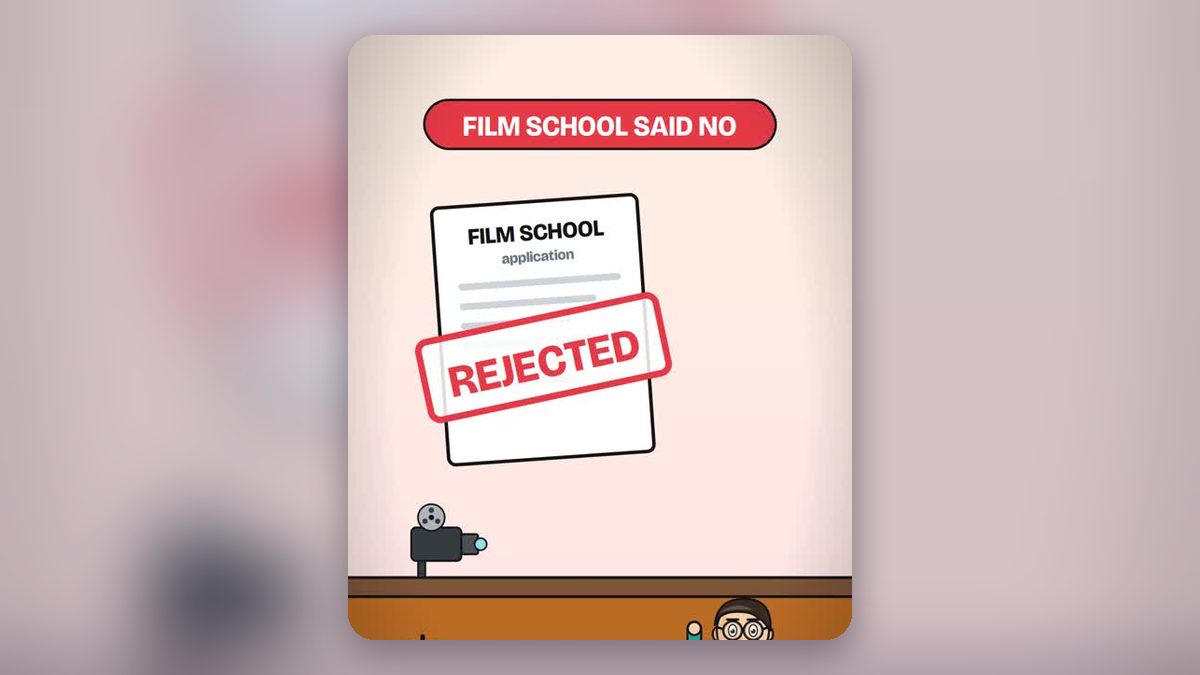
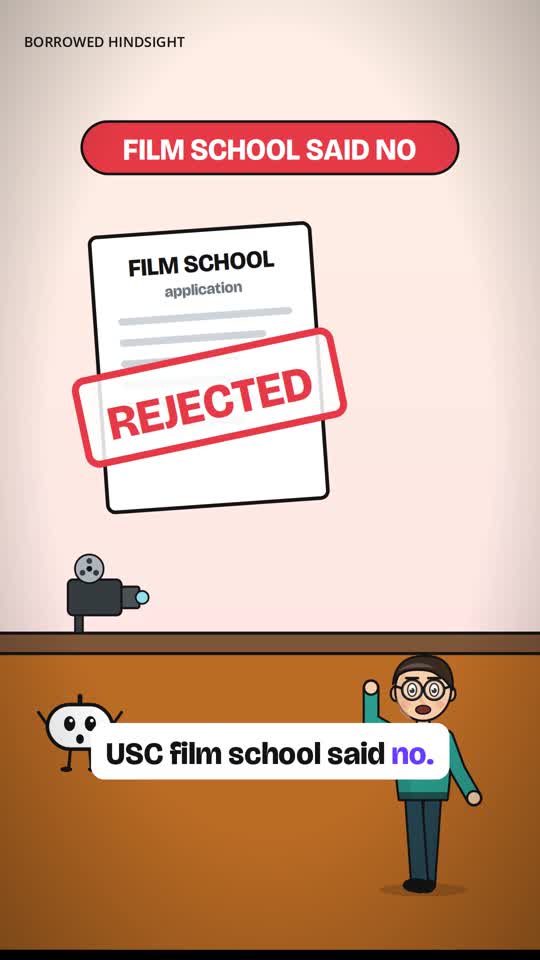
Illustration from the Borrowed Hindsight video about this story.
In this story
- Was Steven Spielberg really rejected by USC film school?
- What had he done before film school?
- Where did Spielberg go instead, and how did Amblin' get him into Hollywood?
- What happened after he left college?
- Why did Spielberg go back to finish his degree at 55?
- What can you learn from Spielberg's rejection? (Myth vs fact)
- Timeline
- The borrowed hindsight
- Questions people ask
- Sources
The most famous film director of his generation could not get into film school. The University of Southern California's School of Cinema turned Steven Spielberg down, and then turned him down again.
He did not wait for a second opinion. He went to a state college nearby, kept making films, signed a studio contract before he graduated, and was directing Jaws before he turned 30. Then, in 2002, at 55, he quietly went back and finished his degree.
Was Steven Spielberg really rejected by USC film school?
Yes. CNN's fact file on Spielberg states that the USC School of Cinema rejected him twice, and Business Insider describes the rejection as happening "not once, but twice." UPI's 2002 report on his graduation and ET Online also record that USC's film school turned down his application.
That rejection is easy to misread with hindsight. USC was, and is, one of the most selective film schools in America. A no from them did not mean he had no talent; it meant one admissions process, on one day, did not pick him.
What had he done before film school?
Plenty. Born in Cincinnati, Ohio, on 18 December 1946, Spielberg filmed family events with an 8 mm camera as a child, according to CNN. Britannica notes that as a teenager he made Escape to Nowhere (1962), a 40-minute war film that won first prize at a film festival.
In 1964, at 17, he released Firelight, a feature-length science-fiction film. CNN and Britannica both list it as his first feature. He had made a full-length film before he finished school. In other words, he already had a body of work when the top film school said no. The work was real; the rejection was an opinion.
Where did Spielberg go instead, and how did Amblin' get him into Hollywood?
He enrolled at California State College, Long Beach (now California State University, Long Beach), starting in 1965, according to UPI. Britannica and ET Online confirm he studied there after the USC rejection.
In 1968 he made Amblin', a short film about two hitchhikers. Britannica reports that a Universal executive saw it and offered him a contract, and /Film describes Universal signing him straight away after seeing it.
He left college to take the job. UPI says he left school after three years to pursue his career; Hello! magazine dates his departure to 1968. Years later, in 1984, he named his production company Amblin Entertainment after that same student short, as CNN notes.
What happened after he left college?
At Universal he started in television, directing episodes of shows such as Columbo, according to Britannica. His TV film Duel premiered on 13 November 1971 (CNN; Britannica). The Sugarland Express followed in 1974.
Then came Jaws in 1975. Britannica calls it one of the highest-grossing films ever made, and CNN notes it is considered the first summer blockbuster, taking $60 million in its first month. The student USC turned down was now the director every studio wanted.
The run continued: Close Encounters of the Third Kind (1977), E.T. the Extra-Terrestrial (1982) and Jurassic Park (1993). For Schindler's List he won the Oscars for Best Picture and Best Director, and he won Best Director again for Saving Private Ryan, as both CNN and TODAY record.
Why did Spielberg go back to finish his degree at 55?
He did not need the paper for his career. Still, in 2001 he re-enrolled at Cal State Long Beach and completed the requirements, according to UPI and Hello!. In May 2002 he received a bachelor's degree in film and electronic arts, at 55.
UPI quoted him saying the degree came "33 years after finishing my principal education." It is the quiet end of the story: the man the film school would not admit still chose to finish what he had started, on his own terms.
What can you learn from Spielberg's rejection? (Myth vs fact)
First, separate the verdict from the work. USC's decision told Spielberg nothing about the films he had already made or the ones he would make next. He kept his attention on the camera, not on the letter.
Second, the second-choice path can be the faster one. At Long Beach he was free to keep shooting, and it was a short film made outside any famous programme that put him in front of a studio executive.
Third, unfinished things can still be finished later. Going back at 55 was not about proving anything to USC. It was a choice to complete his own story. If a door has closed on you, the useful question is not "Why did they say no?" but "What can I make this week anyway?"
Fourth, a no is information about fit, not about worth. His road ran through a state college, a short film and a studio television department, and it still led to some of the most-watched films ever made.
Myth: Spielberg dropped out because he failed at college. Fact: he left because a studio offered him a contract after seeing his short film, and he came back decades later to finish.
Myth: getting rejected by a top school means you are not good enough. Fact: Spielberg had already made a feature-length film when USC said no. One panel's decision did not measure what he could do.
Timeline
- 1946Born in Cincinnati, Ohio, on 18 December
- 1964Releases Firelight, his first feature-length film, at 17
- 1965Starts at California State College, Long Beach, after USC's film school rejects him
- 1968Makes the short film Amblin'; Universal offers him a contract and he leaves college
- 1971His TV film Duel premieres
- 1975Jaws becomes one of the highest-grossing films ever made
- 1994Wins the Oscars for Best Picture and Best Director for Schindler's List
- 2002Graduates from Cal State Long Beach at 55
A rejection is one opinion, not your future. Keep making the work, and let the work answer.
Your check
- Which "no" are you still treating as a final verdict?
- What is one small piece of work you could make this week that answers it?
Questions people ask
How many times was Steven Spielberg rejected by USC?
Two times. CNN's Spielberg fact file and Business Insider both report that USC's School of Cinema rejected him twice.
Did Steven Spielberg finish college?
Yes. He left California State College, Long Beach, in 1968 for a Universal contract, re-enrolled in 2001 and received a bachelor's degree in film and electronic arts in 2002, at 55 (UPI; Britannica).
What film got Steven Spielberg his first Hollywood contract?
Amblin' (1968), a short film about two hitchhikers. A Universal executive saw it and offered him a contract (Britannica; /Film).
Which college did Steven Spielberg go to?
California State College, Long Beach, now California State University, Long Beach, from 1965 (UPI; Britannica).
What is the lesson from Spielberg's USC rejection?
A rejection reflects one panel's decision at one moment. Spielberg already had a feature film behind him, kept making films at a state college, and was directing Jaws within a decade.
Sources
- Steven Spielberg Fast Facts, CNN (via ABC17 News)
- 15 celebrities who didn't get into their dream colleges, Business Insider
- Spielberg wraps college career, UPI, 14 May 2002
- Steven Spielberg, Encyclopaedia Britannica
- Film school dropout Steven Spielberg finally gets his degree, Hello! magazine
- Steven Spielberg used two of his biggest movies to graduate college, /Film
- Steven Spielberg's Oscar nominations history, TODAY
Every fact on this page comes from the sources above, and every number is checked in at least two. General education, not personal or financial advice. Spotted an error? Tell us and we will correct it. Read our editorial standards.