The Biggest Business Comebacks in History: Apple, LEGO, Marvel and More
Apple was 90 days from going bankrupt, LEGO lost DKK 1.9 billion in a year, Marvel filed for bankruptcy. 10 verified business comebacks and what they did.
What is the biggest business comeback in history?
Apple's is the most cited: in 1997 it lost more than $1 billion and Steve Jobs later said it was about 90 days from bankruptcy. Within a year it was profitable again, and it went on to become one of the world's most valuable companies.

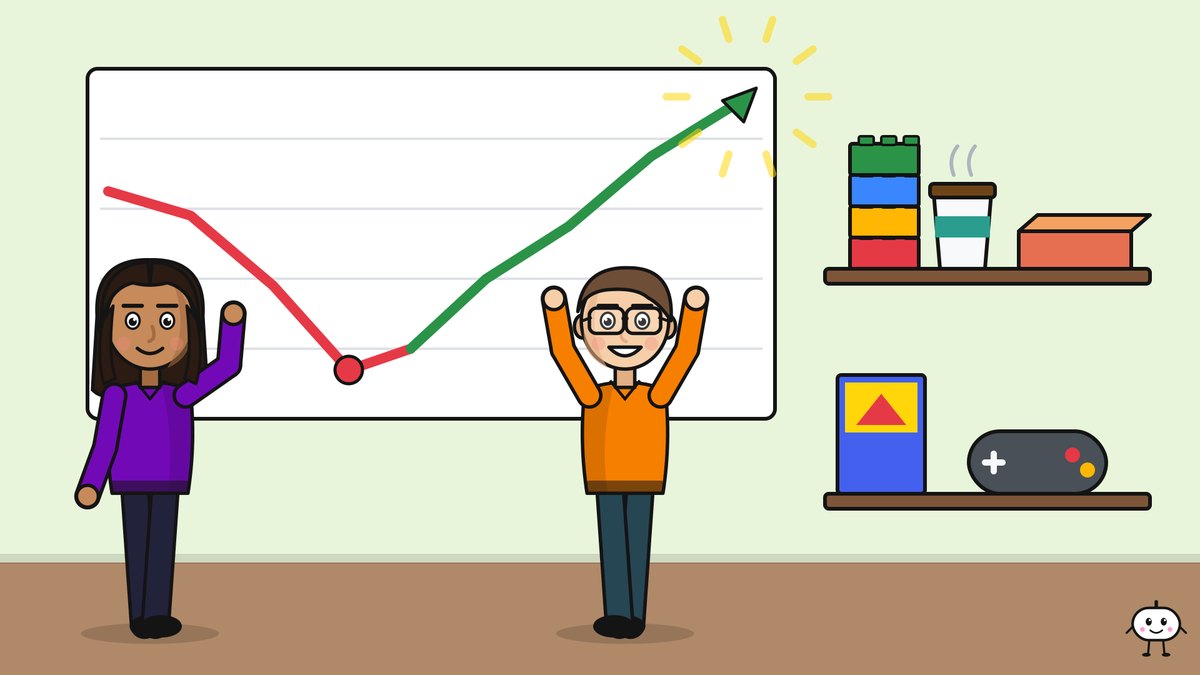
Illustration: two colleagues in front of a wall chart whose line falls to a deep low and then climbs back past where it started, beside a shelf with a tower of toy bricks, a coffee cup, a pizza box, comic books and a game pad.
In this story
- 1. Apple: 90 days from bankruptcy to the iMac
- 2. LEGO: too many bricks, then the world's biggest toymaker
- 3. Marvel: bankruptcy to a $4 billion sale
- 4. Starbucks: closing 7,100 stores for three hours
- 5. Netflix: the Qwikster mistake
- 6. Nintendo: from the Wii U to the Switch
- 7. Domino's: "the crust is like cardboard"
- 8. IBM: an $8 billion loss, and the decision not to split up
- 9. Slack: the failed game that became a $27.7 billion company
- 10. Momofuku Ando: lost nearly everything, then invented instant noodles
- What do the biggest business comebacks have in common?
- The borrowed hindsight
- Questions people ask
- Sources
In 2010, Steve Jobs told a conference audience how close Apple had come to the end when he returned in 1997: "We were 90 days from going bankrupt." Thirteen years later it was one of the most valuable companies in the world.
Apple is the famous one, but it is not alone. Below are ten of the biggest business comebacks on record, from toy bricks to pizza to a failed video game, each checked against at least two reputable sources. For every one we note the low point, what actually changed, and the result, because the useful part of a comeback is rarely luck. It is usually a short list of hard decisions made while things looked worst.
1. Apple: 90 days from bankruptcy to the iMac
Apple lost more than $1 billion in its 1997 financial year (CNN Money; Entrepreneur). Jobs, back at the company he co-founded, later said it had been about 90 days from going bankrupt (The Next Web, reporting his 2010 conference interview; Entrepreneur, citing Walter Isaacson's biography).
His first moves were blunt. He cut about 70% of Apple's product plans (Entrepreneur; CNN via WRAL), and in August 1997 announced a $150 million investment from rival Microsoft, together with a commitment to keep making Office for the Mac (AppleInsider; Engadget). In 1998 came the colourful iMac, on sale that August for $1,299 (Macworld; MacRumors). Apple reported a profit of $309 million for fiscal 1998 (CNN Money; The Register).
The lesson people often miss: the comeback started with doing fewer things, not more.
2. LEGO: too many bricks, then the world's biggest toymaker
In the early 2000s LEGO had expanded into theme parks, video games, clothing and thousands of new parts. In 2004 it lost about DKK 1.9 billion (AP via NBC News; RTÉ), after a pre-tax loss of around DKK 1.4 billion in 2003 (Le Monde; The Motley Fool).
In 2004 Jørgen Vig Knudstorp became chief executive, the first from outside the founding family (Britannica; Entrepreneur). The company sold a majority stake in its Legoland parks to Blackstone in 2005 for €375 million (Blackstone; RTÉ), refocused on the bricks, and cut back the number of separate pieces it made. It was back in profit in 2005 (AP via NBC News), and by the first half of 2014 it had passed Mattel as the world's largest toymaker by sales (Fortune; RTÉ).
3. Marvel: bankruptcy to a $4 billion sale
Marvel Entertainment Group filed for Chapter 11 bankruptcy protection in December 1996 (Marvel's SEC filing; AP via Deseret News). Instead of only licensing its heroes to studios, it later borrowed up to $525 million through Merrill Lynch, putting the film rights to its characters up as collateral, to make its own movies (Variety; The Motley Fool).
The first, Iron Man, opened in May 2008, an independently financed film that launched what became the Marvel Cinematic Universe (AV Club; The Motley Fool). In August 2009 Disney announced it would buy Marvel for about $4 billion (ABC News; Variety). We tell the full story, including the characters Sony once turned down, in Bankrupt in 1996. Sold to Disney for $4 billion in 2009..
4. Starbucks: closing 7,100 stores for three hours
After years of fast growth, Howard Schultz returned as chief executive on 7 January 2008 (Starbucks' own announcement; TIME).
One of his most talked-about moves came on 26 February 2008: about 7,100 US company-run stores closed for three hours in the evening so baristas could be retrained in making espresso (CNN Money; TIME). Later that year Starbucks announced it would close about 600 underperforming US stores (Starbucks' SEC filing; The Washington Times). By fiscal 2010 it reported record revenue of $10.7 billion and net earnings of $945.6 million, up from $390.8 million the year before (Starbucks' results release; Chain Store Age).
5. Netflix: the Qwikster mistake
In July 2011 Netflix split its DVD-by-mail and streaming plans, raising the price for customers who wanted both from $9.99 to $15.98 a month (Bloomberg; CNN Money). In September it announced that the DVD business would become a separate service called Qwikster, then cancelled the plan on 10 October (PCWorld; Marketplace).
In the third quarter of 2011 it lost about 800,000 US subscribers (AP; CNN Money). Its answer was to put its future in streaming and its own shows. House of Cards arrived on 1 February 2013 with all episodes released at once (Netflix; Engadget). By the end of 2024 Netflix had about 301.6 million paid memberships (Screen Daily; Asia Economy).
6. Nintendo: from the Wii U to the Switch
The Wii U was one of Nintendo's weakest consoles: it sold 13.56 million units over its life (Nintendo investor relations; Fortune). Its successor, the Nintendo Switch, passed that total in about ten months (Fortune).
As of 30 September 2026, the Switch had sold 157.20 million units, according to Nintendo's own sales data released in November 2026 (Nintendo investor relations; Gematsu). The same company, a few years apart, went from a console few people bought to one of the best-selling of all time.
7. Domino's: "the crust is like cardboard"
Few companies put their worst reviews in their own adverts. In December 2009 Domino's launched its "Pizza Turnaround" campaign, quoting customers who had called its crust "like cardboard" and introducing a new recipe (Columbia Business School; Campaign). Then-president Patrick Doyle said the company had changed everything on its pizza "from the crust up" (AnnArbor.com).
In the first quarter of 2010 US same-store sales rose 14.3% (Columbia Business School; PMQ). Listening to blunt criticism, and saying so publicly, became the start of a decade of growth.
8. IBM: an $8 billion loss, and the decision not to split up
IBM lost about $8 billion in 1993, much of it from restructuring charges (AP; Encyclopedia of World Biography). Lou Gerstner, the first outsider to run IBM, became chairman and chief executive on 1 April 1993 (AP; Fortune).
At the time, the plan was to break IBM into separate smaller companies. Gerstner stopped it and kept the company whole, focused on serving business customers as one integrated firm (Fortune; IBM). IBM's own tribute calls it the most consequential decision in its modern history. The company was profitable again in 1994, earning roughly $3 billion (AP; Encyclopedia of World Biography).
9. Slack: the failed game that became a $27.7 billion company
In November 2012 a small studio in Vancouver announced that its online game, Glitch, would shut down because it had not found a large enough audience (Engadget; IEEE Spectrum). What survived was the chat tool the team had built for itself while making the game.
That tool launched publicly as Slack in February 2014, and in December 2020 Salesforce agreed to buy it for $27.7 billion. The full story, with sources, is in His game flopped. Its chat tool sold for $27.7 billion..
10. Momofuku Ando: lost nearly everything, then invented instant noodles
Not every comeback is a company. In 1957 Momofuku Ando lost nearly everything when a credit union he was involved with collapsed (Nippon.com; Nissin). He began experimenting in a shed behind his house in Ikeda, near Osaka.
In August 1958 his Chicken Ramen went on sale as the world's first instant noodles, and in 1971 he followed it with Cup Noodles (Nissin; The Japan Times). Read how he did it in He lost almost everything. A year later, he invented instant noodles..
What do the biggest business comebacks have in common?
Look across the ten and a pattern appears. Almost none of them came back by adding more. Apple cut its product plans, LEGO sold its parks and refocused on the brick, Starbucks closed stores, Netflix dropped a bad plan within weeks, and Slack's founders walked away from the game they had spent years on.
The second pattern is honesty about the problem. Domino's printed its customers' complaints, Schultz shut thousands of stores to fix the coffee, and Gerstner rejected the easy break-up plan. Each comeback began the moment someone stopped defending what was not working.
The third is that the turnaround usually took years, not months. LEGO needed about a decade to go from heavy losses to world number one, and Marvel more than ten years from bankruptcy to Disney. The low point is rarely the end of the story; it is often where the useful part begins.
Most comebacks start by stopping something: a product, a plan or a habit that is not working. Doing less, honestly, came before doing better.
Your check
- What is one thing you keep doing only because you have always done it?
- If you had to cut 70% of your plans this month, which 30% would you keep?
Questions people ask
What is the biggest business comeback in history?
Apple's is the most cited: in 1997 it lost more than $1 billion and Steve Jobs later said it was about 90 days from bankruptcy. Within a year it was profitable again, and it went on to become one of the world's most valuable companies.
How did LEGO avoid bankruptcy?
After losing about DKK 1.9 billion in 2004, LEGO appointed Jørgen Vig Knudstorp as CEO, sold a majority of its Legoland parks, refocused on its core bricks and cut the number of pieces it made. It returned to profit in 2005 and became the world's largest toymaker by sales in 2014.
How did Steve Jobs save Apple?
He cut about 70% of Apple's product plans, secured a $150 million investment and an Office for Mac commitment from Microsoft in 1997, and launched the iMac in 1998. Apple reported a $309 million profit for fiscal 1998.
Was Marvel ever bankrupt?
Yes. Marvel Entertainment Group filed for Chapter 11 bankruptcy in December 1996. It later financed its own films, starting with Iron Man in 2008, and Disney agreed to buy it for about $4 billion in 2009.
Why did Starbucks close all its stores in 2008?
On 26 February 2008 about 7,100 US company-operated Starbucks stores closed for three hours so baristas could be retrained in making espresso, part of Howard Schultz's turnaround after he returned as CEO.
Sources
- The Next Web: Steve Jobs, Apple was 90 days from going bankrupt (2010)
- Entrepreneur: How Steve Jobs saved Apple (2011)
- CNN Money: Apple posts profit for fiscal 1998
- AppleInsider: August 6, 1997, the day Apple and Microsoft made peace
- AP via NBC News: Lego reports return to profitability in 2005
- Fortune: Lego is now the world's top toymaker (2014)
- Blackstone: Blackstone acquires Legoland (2005)
- Variety: How Marvel assembled its Avengers (2012)
- ABC News: Disney to buy Marvel for $4 billion (2009)
- CNN Money: Starbucks closes stores for barista training (2008)
- Starbucks fiscal 2010 results (SEC filing)
- CNN Money: Netflix loses 800,000 subscribers (2011)
- Nintendo IR: Dedicated video game sales units
- Columbia Business School: Domino's wins by eating a little humble pie
- Fortune: Lou Gerstner, IBM's turnaround CEO (2025)
Every fact on this page comes from the sources above, and every number is checked in at least two. General education, not personal or financial advice. Spotted an error? Tell us and we will correct it. Read our editorial standards.