Business Deals That Were Turned Down: 10 "No"s That Cost Billions
Excite passed on Google, Yahoo refused $44.6 billion, Sony skipped the Avengers. 10 famous turned-down deals, with sources, and what each one teaches.
Did Excite really turn down buying Google?
Yes. Investor Vinod Khosla said in 2010 that Google's founders agreed to sell to Excite in 1999 and that he negotiated the price down to $750,000, but Excite's CEO George Bell declined. Bell told CNBC in 2015 that his main objection was Larry Page's demand to replace Excite's search technology with Google's.

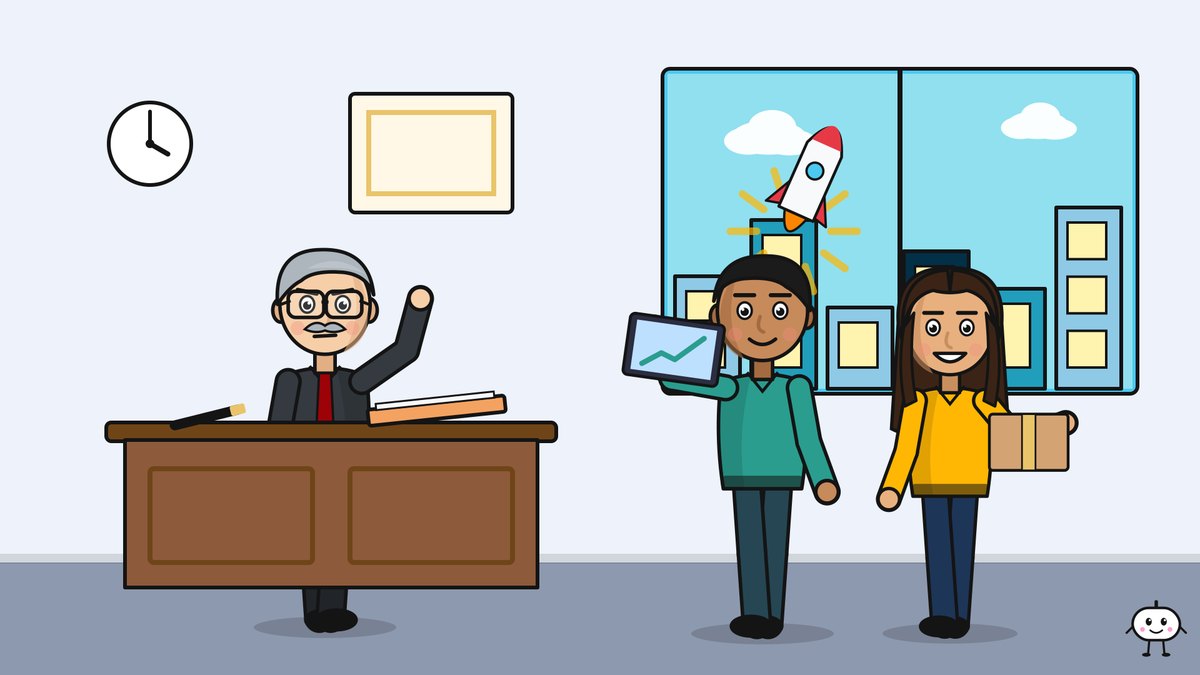
Illustration: a senior executive behind his desk holding up a hand to say no to two hopeful young founders with a laptop and a parcel, while through the office window a rocket lifts off over the city.
In this story
- 1. Excite: the chance to buy Google for under $1 million (1999)
- 2. Blockbuster: Netflix for $50 million (2000)
- 3. Yahoo: Microsoft's $44.6 billion offer (2008)
- 4. Friendster: Google's $30 million offer (2003)
- 5. Groupon: Google's offer of about $6 billion (2010)
- 6. Sony: almost every Marvel hero for $25 million (1998)
- 7. Decca: the Beatles audition (1962)
- 8. Hewlett-Packard: Steve Wozniak's computer, five times
- 9. IBM, GE and RCA: the photocopier nobody wanted
- 10. Hollywood studios: Star Wars
- The other side: two "no"s that were exactly right
- What these turned-down deals have in common
- The borrowed hindsight
- Questions people ask
- Sources
In 1999, two Stanford graduates were ready to sell their search engine for less than a million dollars. The buyer they approached, Excite, said no. The search engine was Google.
Stories like this get passed around as jokes about foolish executives. The real versions are more useful. Most of these people had sensible reasons at the time, and that is exactly why the lessons matter: the same reasons will sound sensible to you one day too. Here are 10 famous business deals that were turned down, checked against reputable sources, plus two refusals that turned out to be right.
1. Excite: the chance to buy Google for under $1 million (1999)
Larry Page and Sergey Brin were keen to get back to their studies and were willing to sell. Investor Vinod Khosla, who told the story on stage at TechCrunch Disrupt in 2010, said the founders agreed to a price of $1 million and that he talked them down to $750,000. Excite's chief executive, George Bell, still said no.
Bell has given his own side. He told CNBC in 2015 that money was not the real obstacle: Page insisted that Excite rip out its own search technology and replace it with Google's, and Bell says he chose his company's culture over the opportunity. Excite was later sold on and faded. Google became one of the most valuable companies in the world.
2. Blockbuster: Netflix for $50 million (2000)
In 2000, Reed Hastings and Marc Randolph flew to Dallas and offered their small, loss-making DVD-by-mail company to Blockbuster for $50 million. Blockbuster, then the giant of video rental, declined. Randolph later said they were laughed out of the room.
Blockbuster did eventually build its own online service, and for a while it gave Netflix a real fight. But it filed for bankruptcy in 2010, while Netflix moved into streaming. The full story is here: They could've bought Netflix for $50 million. Saying no made sense.
3. Yahoo: Microsoft's $44.6 billion offer (2008)
On 1 February 2008, Microsoft offered to buy Yahoo for $31 a share, about $44.6 billion. Yahoo's stock had been trading below $20, so it was a large premium. Ten days later, Yahoo's board rejected it, saying the offer "substantially undervalues" the company.
Nine years later, in June 2017, Verizon completed its purchase of Yahoo's core business for about $4.48 billion, roughly a tenth of what Microsoft had offered. Yahoo's board believed in its own future, and that belief was not unreasonable in 2008; the internet simply moved faster than anyone inside expected.
4. Friendster: Google's $30 million offer (2003)
Before Facebook and MySpace, there was Friendster, one of the first popular social networks. In 2003, Google offered about $30 million for it, according to TechCrunch and Mental Floss. Founder Jonathan Abrams turned the offer down; Mental Floss reports that investors told him the long-term prize was too big to give up, and he took venture funding instead.
Within a few years, its users had moved on to MySpace and then Facebook. A $30 million offer in Google stock in 2003, before Google went public, is one of the most painful "what ifs" in tech.
5. Groupon: Google's offer of about $6 billion (2010)
In December 2010, Groupon, the daily-deals company, turned down a reported takeover offer from Google of about $6 billion, according to the Chicago Tribune as reported by The Next Web, and eWeek. Groupon reportedly believed it was strong enough to stay independent.
It went public instead, in November 2011, at $20 a share. Within three weeks the shares had already slipped below that price. Whether Groupon should have sold is still debated, but it remains the classic example of an offer that looked too small at the time.
6. Sony: almost every Marvel hero for $25 million (1998)
In 1998, Marvel was just out of bankruptcy and needed cash. According to Ben Fritz's book The Big Picture, excerpted in The Wall Street Journal and reported by Quartz and /Film, Marvel offered Sony the film rights to nearly all its characters, including Iron Man, Thor and Black Panther, for $25 million. Sony wanted only Spider-Man.
Marvel went on to make those films itself and was bought by Disney for about $4 billion in 2009. How Marvel climbed back is told here: Bankrupt in 1996. Sold to Disney for $4 billion in 2009.
7. Decca: the Beatles audition (1962)
On New Year's Day 1962, a young band from Liverpool played 15 songs at Decca's London studio. Decca passed and signed another group instead. Months later, the Beatles signed with EMI's Parlophone label.
The famous line "guitar groups are on their way out" is often pinned on Decca's Dick Rowe, but he denied saying it all his life. Decca's consolation: on a tip from George Harrison, it later signed the Rolling Stones. Read the full story: Decca said no to the Beatles. Then it signed the Rolling Stones.
8. Hewlett-Packard: Steve Wozniak's computer, five times
Steve Wozniak designed the computer that became the Apple I while he was working at HP. He felt he owed his employer the first chance at it. He has said, including at the Computer History Museum, that HP turned him down five times.
Wozniak has also said that by the end he was hoping they would say no, because he wanted to build Apple. HP stayed a successful company, but it let a personal computer built by one of its own engineers walk out of the door.
9. IBM, GE and RCA: the photocopier nobody wanted
On 22 October 1938, in a makeshift lab in Astoria, New York, inventor Chester Carlson made the first dry copy of an image using static electricity, a process later called xerography. Over the next years he showed it to major companies, including IBM, General Electric and RCA. They turned him down. It took him years, through the Second World War, to find anyone willing to back it.
The non-profit Battelle Memorial Institute backed the research in 1944, and a small Rochester company called Haloid bought into it. Haloid later renamed itself Xerox, and its Xerox 914 copier went into production in 1959. The idea that big companies passed on became the word people used for copying itself.
10. Hollywood studios: Star Wars
In the early 1970s, George Lucas went looking for a studio to fund his space film. United Artists passed. Universal, which had backed his hit American Graffiti, also let the project go, deciding it would cost too much, according to the American Film Institute's catalog.
Alan Ladd Jr., then a creative executive at 20th Century Fox, had loved American Graffiti and agreed to take a chance on Lucas. Star Wars opened in 1977 and became one of the most successful film series of all time.
The other side: two "no"s that were exactly right
Not every refusal is a mistake. In 2006, Yahoo offered about $1 billion for Facebook. Mark Zuckerberg, then 22, said no, according to the books Becoming Facebook and An Ugly Truth. He has said the painful part was not the refusal itself, but that many of his staff left afterwards because they did not believe in it.
In India, around 1990, Infosys was offered $1 million, and some of its founders were tempted to sell. Narayana Murthy has said he argued against it and was even ready to buy out his colleagues, though he had no money to do it. They stayed. How Infosys began: How Infosys Started With ₹10,000 From Sudha Murty (1981)
What these turned-down deals have in common
Almost every "no" on this list was judged against the business as it stood that day: Blockbuster's stores, Excite's search, Sony's need for one hit, Hollywood's budgets. The people saying yes were judging what the thing could become.
None of this means you should say yes to everything. Zuckerberg and Murthy said no too. The difference is what they were refusing: a price, not a future they believed in. The executives on this list were often refusing a future they could not yet see.
That is the borrowed hindsight. Before you turn something down, ask two questions: would I still say no if this grew ten times bigger, and am I refusing the idea or just the way it looks today?
Most famous bad "no"s judged the idea as it looked that day, not what it could become. Before you refuse, picture it ten times bigger.
Your check
- What is one offer, idea or person you turned down because of how it looked today?
- Would you still say no if it became ten times bigger?
Questions people ask
Did Excite really turn down buying Google?
Yes. Investor Vinod Khosla said in 2010 that Google's founders agreed to sell to Excite in 1999 and that he negotiated the price down to $750,000, but Excite's CEO George Bell declined. Bell told CNBC in 2015 that his main objection was Larry Page's demand to replace Excite's search technology with Google's.
How much did Microsoft offer for Yahoo?
In February 2008 Microsoft offered $31 a share, about $44.6 billion. Yahoo's board rejected it as too low. In 2017 Verizon bought Yahoo's core business for about $4.48 billion.
Did Sony really turn down the Marvel characters?
According to Ben Fritz's book The Big Picture, excerpted in The Wall Street Journal, Marvel offered Sony the film rights to almost all its characters in 1998 for $25 million. Sony only wanted Spider-Man.
How much did Netflix ask Blockbuster for?
In 2000, Netflix's founders offered to sell the company to Blockbuster for $50 million. Blockbuster declined, and filed for bankruptcy in 2010.
Which companies turned down the photocopier?
Chester Carlson, who made the first xerographic copy in 1938, was turned down by large companies including IBM, General Electric and RCA. Haloid, later renamed Xerox, took the idea to market.
Sources
- TechCrunch, MG Siegler: When Google wanted to sell to Excite for under $1 million (29 Sep 2010)
- CNBC: Dotcom bubble CEO: why I passed on buying Google (2 Mar 2015)
- CBS News: Yahoo rejects Microsoft's $44.6B offer (Feb 2008)
- NPR: Yahoo rejects Microsoft bid (11 Feb 2008)
- Fortune: Verizon closes Yahoo acquisition (13 Jun 2017)
- TechCrunch: The Friendster tell-all story (15 Oct 2006)
- Mental Floss: Antisocial media, the rise and fall of Friendster
- eWeek: Groupon reportedly turns down $6B Google takeover offer (Dec 2010)
- The Next Web: Groupon reportedly rejects Google's offer (4 Dec 2010)
- TechCrunch: Three weeks later, Groupon's stock falls below IPO price (23 Nov 2011)
- Quartz: Sony turned down the rights to Black Panther and the Avengers in 1998 (2018)
- Computerworld: Steve Wozniak on Apple's founding
- CIO: Chester Floyd Carlson, father of the photocopy
- The Henry Ford: Light and static, the origins of the Xerox copy
- AFI Catalog: Star Wars (1977)
Every fact on this page comes from the sources above, and every number is checked in at least two. General education, not personal or financial advice. Spotted an error? Tell us and we will correct it. Read our editorial standards.