The Amul Story: How 247 Litres of Milk From Two Villages Became India's Biggest Dairy Brand
In 1946, farmers in Kheda formed a cooperative with two village societies and 247 litres of milk. It became Amul. The true story, with sources.
How did Amul start?
Amul started in 1946 when dairy farmers in Kheda (Kaira) district, Gujarat, formed the Kaira District Co-operative Milk Producers' Union after a milk strike against a monopoly buyer. It began with two village dairy societies and 247 litres of milk.

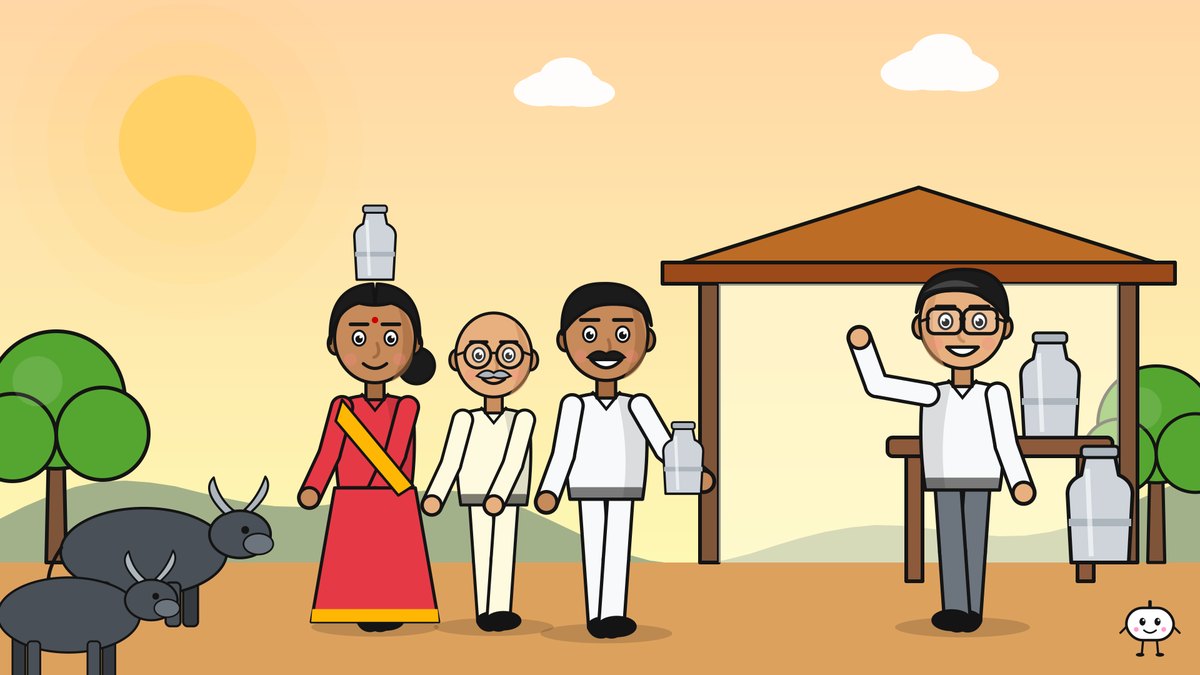
Illustration: a village milk collection shed at sunrise in Gujarat: a woman carries a steel milk can on her head, farmers queue with their cans, buffaloes rest nearby, and a young manager in glasses receives the milk at a table.
In this story
- Why did the farmers of Kheda start their own dairy?
- Who built Amul: Tribhuvandas Patel, Verghese Kurien and H. M. Dalaya
- What was Amul's 'impossible' breakthrough?
- Where did the name Amul and the Amul girl come from?
- How did the Amul model spread across India?
- How big is Amul today, and what do people get wrong?
- The money behind it
- Timeline
- The borrowed hindsight
- Questions people ask
- Sources
In 1946, a group of dairy farmers in Kheda district, Gujarat, were tired of selling their milk for whatever one buyer offered. So they started their own cooperative. It began with just two village dairy societies and 247 litres of milk, according to Outlook and the dairy trade paper DairyNews7x7.
That cooperative is Amul. In 2025-26 the Amul brand's turnover crossed ₹1 lakh crore, and it is owned by about 36 lakh dairy farmers, Lokmat Times and AgroSpectrum reported in April 2026. Here is how a few cans of milk became India's biggest dairy brand, and what most retellings get wrong.
Why did the farmers of Kheda start their own dairy?
In the 1940s, milk from Kheda (then called Kaira) went to the city through one private dairy, Polson, which held a monopoly on collecting it, ThePrint reports. Under the government's Bombay Milk Scheme, Kaira's milk was shipped to the city through that one dairy, and the farmers who produced it had almost no say in the price.
In 1946 the farmers refused to sell to the monopoly and went on a milk strike, both ThePrint and DairyNews7x7 report. Led by Tribhuvandas Patel, who became the founder chairman, they registered the Kaira District Co-operative Milk Producers' Union by December 1946. The idea was simple: the farmers would own the dairy, so the money from their milk would come back to them.
Who built Amul: Tribhuvandas Patel, Verghese Kurien and H. M. Dalaya
Verghese Kurien did not plan to stay. Britannica says he came to Anand in 1949 to work at a government creamery as a condition of his scholarship to Michigan State University. The farmers' cooperative asked for his help, and he became its manager; the government's New India Samachar dates his joining to 1 January 1950, and Outlook also puts it in 1950.
He worked with chairman Tribhuvandas Patel and dairy engineer Harichand Megha Dalaya. DairyNews7x7 credits the three of them, together, with building the dairy. None of them owned it. That was the point: the owners were the farmers who poured milk into the cans every morning and evening.
What was Amul's 'impossible' breakthrough?
Most of Kheda's milk came from buffaloes, and experts abroad believed milk powder could only be made from cow's milk. Kurien and Dalaya proved them wrong, says New India Samachar. ThePrint describes Dalaya's method of spray-drying buffalo milk into powder as something dairy technologists had thought could not be done.
Amul Dairy's own history says the world's first buffalo-milk spray dryer was installed in Anand in 1955. It mattered for a practical reason: in the flush season farmers produced more milk than the city could drink. Turning the surplus into powder meant the cooperative could keep buying from them all year.
Where did the name Amul and the Amul girl come from?
The name comes from the Sanskrit word 'amulya', meaning priceless, ThePrint reports. Sources differ on the year: New India Samachar says the brand was named in 1955, while ThePrint says it was registered in 1957.
The famous mascot came later. In 1966, Sylvester daCunha of the agency Advertising and Sales Promotion conceived the chubby girl in a polka-dot dress, and art director Eustace Fernandes drew her, Khaleej Times and Storyboard18 report. Because television sets and print ads were out of reach for many households, she first appeared on hoardings, and she has been commenting on the news with a pun ever since.
How did the Amul model spread across India?
Once Anand worked, the country copied it. In 1965 Kurien became the first chairman of the National Dairy Development Board, set up to build cooperatives on the Anand pattern, Britannica and New India Samachar report. Operation Flood, the programme that linked village cooperatives to cities across India, began at the start of the 1970s.
The result is one of the great turnarounds in food history. India became the world's largest milk producer, overtaking the United States in 1998, according to New India Samachar and DailyO. Even the film about the movement was farmer-owned: Shyam Benegal's Manthan (1976) was paid for by about five lakh dairy farmers who gave ₹2 each, Deccan Herald and The Tribune report. A restored version screened at Cannes in 2024.
How big is Amul today, and what do people get wrong?
Today the Gujarat Co-operative Milk Marketing Federation (GCMMF), which markets Amul, has 18 member district unions. Its own turnover was ₹73,450 crore in 2025-26, up from ₹65,911 crore, and the wider Amul brand passed ₹1 lakh crore, Lokmat Times and AgroSpectrum report. The Week (PTI) says the network collects milk from about 36 lakh farmers.
The common myth is that Kurien founded Amul. He did not: the farmers had already formed their union in 1946, before he arrived, and he built it as their employee. The other myth is that big brands need big money to start. Amul started with 247 litres. Like Lijjat Papad (Seven women, ₹80 and one rooftop: the Lijjat Papad story) and Nirma (Homemade detergent at ₹3 a kilo: how Karsanbhai Patel's Nirma beat the big brands), it grew because ordinary people kept showing up, day after day.
That is the borrowed hindsight in this story. The farmers of Kheda did not wait for a big investor or a perfect plan. They had a problem they all shared, a small amount of milk each, and a decision to work together. If you have a small idea and two or three people who care about it as much as you do, that is a real start, not a weak one.
The money behind it
By Manisha Aggarwal, accounting professional
In 2025-26 the Amul brand's turnover crossed ₹1 lakh crore. Spread across about 36 lakh farmer-owners, that is roughly ₹2.8 lakh of sales for each farmer family, though it is turnover, not profit.
The federation's own turnover rose from ₹65,911 crore to ₹73,450 crore, about 11% in a year. Even the film Manthan (1976) was paid for by about five lakh farmers giving ₹2 each. That ₹2 is worth about ₹63 today, and the total of about ₹10 lakh would be about ₹3.1 crore.
| Amul brand turnover (2025-26) | over ₹1 lakh crore |
|---|---|
| Sales per farmer-owner | about ₹2.8 lakh |
| Federation turnover growth in 2025-26 | about 11% |
| Farmers' ₹2 each for Manthan (1976), today | about ₹63 each |
Inflation uses India's consumer price index from the World Bank (series FP.CPI.TOTL, to 2025). Figures are rounded. General education, not financial advice.
Try it yourself: inflation calculator · growth-rate (CAGR) calculator
Timeline
- 1946Kheda's farmers strike and register their own union, starting with two village societies and 247 litres of milk
- 1949Verghese Kurien arrives in Anand to work at a government creamery
- 1955The world's first buffalo-milk spray dryer is installed at Amul Dairy
- 1965Kurien becomes the first chairman of the National Dairy Development Board
- 1966The Amul girl first appears on hoardings
- 1976Manthan, paid for by about five lakh farmers at ₹2 each, is released
- 1998India becomes the world's largest milk producer
You don't need big money to build something big. You need a small group who own it together and keep showing up.
Your check
- What could you start this month with the small amount you already have?
- Who are the two or three people who would build it with you?
Questions people ask
How did Amul start?
Amul started in 1946 when dairy farmers in Kheda (Kaira) district, Gujarat, formed the Kaira District Co-operative Milk Producers' Union after a milk strike against a monopoly buyer. It began with two village dairy societies and 247 litres of milk.
Who is the founder of Amul?
The farmers' union was founded in 1946 with Tribhuvandas Patel as its founder chairman. Verghese Kurien joined as manager around 1950 and, with engineer H. M. Dalaya, built it into a modern dairy. The farmers have always been its owners.
What is the full form or meaning of Amul?
Amul comes from the Sanskrit word 'amulya', meaning priceless. Sources differ on whether the brand name was adopted in 1955 or registered in 1957.
Who owns Amul?
Amul is owned by about 36 lakh dairy farmers through their village societies and district unions. The Gujarat Co-operative Milk Marketing Federation (GCMMF), with 18 member unions, markets the brand.
What is Amul's turnover?
In 2025-26, GCMMF's turnover was ₹73,450 crore and the Amul brand's total turnover crossed ₹1 lakh crore, up about 11% from the previous year.
Sources
- Outlook Spotlight: How dreams turn reality (Kaira union, 247 litres, two village societies)
- DairyNews7x7: The utterly butterly story of India's 75-year-old iconic brand Amul
- ThePrint: Polson to Amul (TR Vivek, 18 May 2023)
- Britannica: Verghese Kurien
- New India Samachar (Government of India), 16-30 Nov 2022: Verghese Kurien
- Amul Dairy: Dr. H M Dalaya
- Amul Dairy: Dr. Verghese Kurien
- Khaleej Times: Amul girl at 50
- Storyboard18: Sylvester daCunha, the man behind the Amul girl
- DailyO: Looking back at Operation Flood
- Deccan Herald: The return of Manthan
- The Tribune: Farmers made Manthan successful, says Shyam Benegal
- Lokmat Times: Amul brand's turnover crosses Rs 1 lakh crore (Apr 2026)
- AgroSpectrum India: Amul's turnover tops Rs 1 lakh crore (10 Apr 2026)
- The Week (PTI): Amul brand FY25 revenue rises 12 pc to Rs 90k cr (2 Apr 2025)
Every fact on this page comes from the sources above, and every number is checked in at least two. General education, not personal or financial advice. Spotted an error? Tell us and we will correct it. Read our editorial standards.