Stephen King threw Carrie in the trash. His wife pulled it out.
Stephen King threw the first pages of Carrie in the bin. His wife Tabitha pulled them out. The paperback rights later sold for $400,000.
Did Stephen King throw Carrie away?
Yes. He threw the first few pages in the wastebasket because he thought they were not working. His wife Tabitha pulled them out, read them and urged him to keep going.

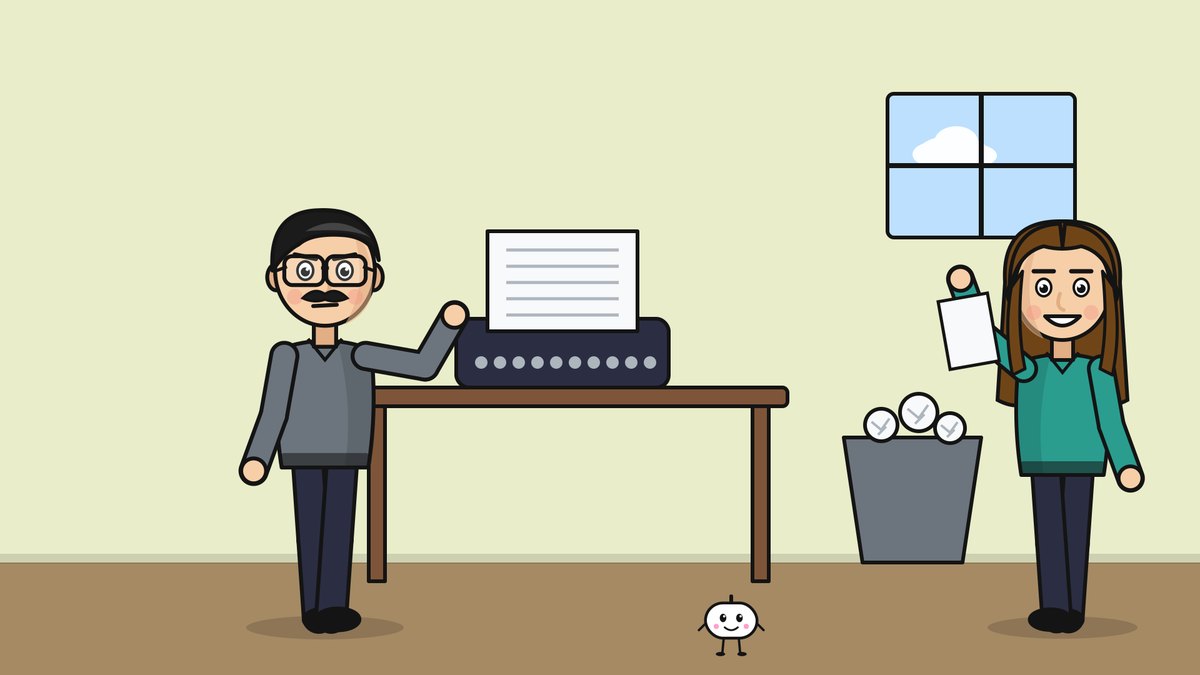
Illustration: a writer at a typewriter while his wife rescues crumpled pages from the wastebasket.
In this story
In the early 1970s, a young high school English teacher in Maine typed a few pages of a story, decided they were no good, and threw them in the wastebasket. The next day his wife found them, brushed off the cigarette ash, and read them.
The teacher was Stephen King. The pages became Carrie, his first published novel, and the start of one of the best-selling writing careers in the world. In a 2024 interview with The Boston Globe, King put it simply: Tabby literally picked it out of the wastebasket.
Who was Stephen King before Carrie?
Before he was famous, King was a teacher at Hampden Academy, a high school in Maine, and money was tight. In a 1979 excerpt published by Yankee Magazine, he recalled working in a laundry during the summer to help make ends meet. The Boston Globe reported that he also wrote while working in a commercial laundry.
The family lived in a trailer. Tabitha King later wrote that he worked in a tiny room meant to be the laundry room, even though they had no washer or dryer, according to the Globe. King told the newspaper, "We were scraping bottom."
He wrote at night and in spare moments, and he had been writing for years. Kirkus Reviews noted that by the early 1970s he already had several unpublished novels in a desk drawer.
Why Stephen King threw Carrie away
Carrie began as an idea for a short story about a bullied teenage girl who discovers she has telekinetic powers. King did not think it was working. He told The Boston Globe that it was too hard and already too long for a short story.
Accounts of exactly how much he had written vary slightly. In the Yankee Magazine excerpt he says he threw out four pages; Mental Floss, drawing on his memoir On Writing, describes three single-spaced pages. Either way, it was the very start of the book, and he was ready to give up on it.
Mental Floss quotes King's own explanation from On Writing: he threw it away because he doubted anyone would want to read a book about a poor, awkward girl like Carrie. He could not see past his own doubts.
How Tabitha King saved Carrie
Tabitha King, known as Tabby, found the crumpled pages in the bin, smoothed them out and read them. She saw something in them that her husband had missed.
In the 1979 Yankee Magazine account, King says she left him a note: "Please keep going—it's good." In On Writing, as quoted by Mental Floss, he remembers her telling him that he had something there.
King has said that her praise was rare, which made it count. He went back to the manuscript and kept going. Kirkus Reviews reported that the story grew from a short story into a full novel. Every edition of Carrie carries a dedication to Tabby, thanking her for getting him into it and then bailing him out of it.
The $2,500 advance and the $400,000 phone call
King sent the finished manuscript to Doubleday. Editor Bill Thompson accepted it and offered an advance of $2,500, a figure reported by The Boston Globe, Kirkus Reviews and Yankee Magazine. Mental Floss reports that King used the money to buy a car and move the family out of the trailer.
Carrie was published in April 1974. The bigger news came with the paperback. The paperback rights sold for $400,000, as both Yankee Magazine and Mental Floss report; Mental Floss names the buyer as Signet Books.
In the Yankee account, King says he first misheard the figure as $40,000. When he understood it was $400,000, he realised he would not have to teach anymore. He soon left the classroom to write full-time, as Kirkus Reviews and Mental Floss also note.
What happened after Carrie
The hardcover sold slowly at first. Kirkus Reviews contributing editor Gregory McNamee recalled selling only a copy or two a day at a bookshop, far fewer than the hit novel Jaws. The paperback did much better, and King told the Globe it became a bestseller after the 1976 film adaptation directed by Brian De Palma.
Within a few years, Kirkus Reviews notes, King had also published 'Salem's Lot, The Shining and The Stand. Carrie had opened the door, and he walked through it with book after book.
Despite all that, King has mixed feelings about his first novel. He told the Globe that Carrie changed his life, but that he has never really liked it all that much.
Why this story matters to anyone who makes things
There was no lucky meeting here and no famous mentor. The turning point was a few crumpled sheets of paper and one honest reader at home. The person closest to a piece of work is often its harshest judge, and a second pair of eyes can see what the creator cannot.
It also says something about the reader. Tabitha did not flatter him; King has said her praise was rare. What she offered was an honest second opinion at the moment he was about to quit. If you make things, it is worth having one person like that, and it is worth being that person for someone else.
The money behind it
By Manisha Aggarwal, accounting professional
Doubleday's advance for Carrie was $2,500. The paperback rights then sold for $400,000, 160 times as much.
For a teacher earning a modest salary, that difference was life-changing. King said he realised he would not have to teach any more. An advance is a prepayment against future royalties; the paperback sale showed what the book was actually worth to the market.
| Hardback advance | $2,500 |
|---|---|
| Paperback rights sale | $400,000 |
| Paperback vs advance | 160 times |
Figures come from the sources listed below and are rounded. General education, not financial advice.
Try it yourself: inflation calculator · growth-rate (CAGR) calculator
Timeline
- Early 1970sTeaching at Hampden Academy, King starts Carrie, throws out the first pages, and Tabitha retrieves them
- Early 1970sDoubleday accepts Carrie with a $2,500 advance
- April 1974Carrie is published in hardcover by Doubleday
- Mid-1970sPaperback rights sell for $400,000 and King leaves teaching to write full-time
- 1976Brian De Palma's film of Carrie is released
What you are about to throw away might be the one. Let someone you trust read it before you decide.
Your check
- What draft, idea or project is sitting in your bin right now?
- Who could you show it to before you give up on it?
Questions people ask
Did Stephen King throw Carrie away?
Yes. He threw the first few pages in the wastebasket because he thought they were not working. His wife Tabitha pulled them out, read them and urged him to keep going.
How much was Stephen King paid for Carrie?
Doubleday paid him a $2,500 advance for Carrie. The paperback rights were later sold for $400,000 (Mental Floss names the buyer as Signet Books), the deal that let King give up teaching. Our sources confirm those two figures; reports of exactly how the $400,000 was split between Doubleday and King vary, so we don't state a number for his share.
When was Carrie published?
Carrie was published in hardcover by Doubleday in April 1974. It was Stephen King's first published novel.
What did Tabitha King say about Carrie?
In a 1979 account published by Yankee Magazine, King said she left him a note reading "Please keep going—it's good." In his memoir On Writing he recalls her telling him he had something there.
What was Stephen King's job when he wrote Carrie?
He was a high school English teacher at Hampden Academy in Maine, and he also worked in a laundry to make ends meet. The family lived in a trailer.
Sources
- Yankee Magazine (March 1979): Stephen King (excerpt)
- The Boston Globe (4 April 2024): Stephen King exclusive: 'Carrie,' his first horror novel, turns 50
- Kirkus Reviews (19 May 2014): Appreciations: Carrie turns 40
- Mental Floss: How Stephen King's wife saved Carrie and launched his career
Every fact on this page comes from the sources above, and every number is checked in at least two. General education, not personal or financial advice. Spotted an error? Tell us and we will correct it. Read our editorial standards.