Famous People Who Failed Before They Succeeded: 15 True Stories (With Sources)
15 famous people who failed first: rejected manuscripts, lost jobs, bankrupt studios and missed selections, each with the real numbers and sources.
Which famous people failed before they succeeded?
Well-documented examples include J.K. Rowling, whose first Harry Potter book was rejected by several publishers; Walt Disney, whose first studio went bankrupt in 1923; Steve Jobs, who was pushed out of Apple in 1985; and APJ Abdul Kalam, who missed selection as an Indian Air Force pilot by one place.

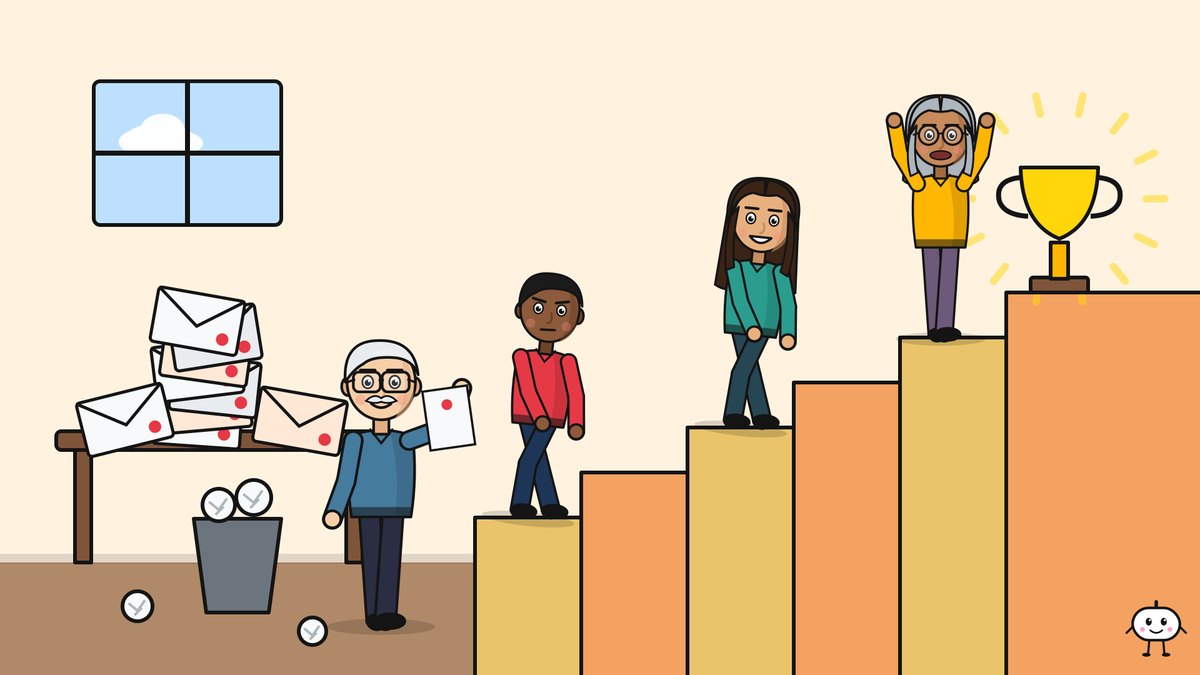
Illustration: a desk piled with rejection letters and crumpled drafts beside a staircase, where people of different ages climb towards a golden trophy at the top.
In this story
- 1. J.K. Rowling: Harry Potter was turned down by a string of publishers
- 2. Walt Disney: his first studio went bankrupt in 1923
- 3. Oprah Winfrey: removed from the evening news after less than eight months
- 4. Michael Jordan: left off the varsity list as a 15-year-old
- 5. Steve Jobs: pushed out of the company he co-founded at 30
- 6. Jack Ma: 24 people applied to KFC, 23 were hired
- 7. Soichiro Honda: his first piston rings were rejected by Toyota
- 8. Amitabh Bachchan: a failed company, heavy debt and a comeback
- 9. APJ Abdul Kalam: ninth in a selection with eight places
- 10. Narayana Murthy: his first company closed in less than a year
- 11. Sachin Tendulkar: told to give up fast bowling at 14
- 12. Stephen King: his first novel's opening pages went in the bin
- 13. James Dyson: 5,127 prototypes before one worked
- 14. Colonel Sanders: starting over at 65 on $105 a month
- 15. Manoj Kumar Sharma: failed Class 12, cleared UPSC on his fourth attempt
- The borrowed hindsight
- Questions people ask
- Sources
In 1923 a young cartoonist in Kansas City watched his first studio go bankrupt. He left for California carrying little more than an unfinished reel of film. Five years later, his new studio released Steamboat Willie. His name was Walt Disney.
Stories like his get passed around so often that the details blur, and some popular versions are simply untrue. So we went back to the record. Every person below failed, was rejected or was pushed out before the work they are known for, and every number has been checked against reputable sources, listed at the end. Where sources disagree, we say so.
1. J.K. Rowling: Harry Potter was turned down by a string of publishers
Before Harry Potter was a phenomenon, it was a manuscript that kept coming back. Voice of America reports that 12 publishers rejected the first book. Bloomsbury's founder Nigel Newton remembers a smaller number: he told the New Zealand Herald that "eight others turned J K Rowling down; ie, the whole lot." The exact count differs, but the pattern is the same: almost everyone said no.
Bloomsbury said yes partly because Newton's eight-year-old daughter, Alice, read a chapter and loved it. Rowling received an advance of £2,500, a figure both the New Zealand Herald and The Express Tribune report. The first book came out in 1997, and VOA notes that only 500 copies went to bookshops in Britain at first.
2. Walt Disney: his first studio went bankrupt in 1923
Disney's first company, Laugh-O-Gram Films in Kansas City, made short cartoons. According to Britannica, a New York distributor cheated the young producers, and Disney was forced to file for bankruptcy in 1923. The US National Archives at Kansas City still holds the bankruptcy case file.
The Walt Disney Family Museum describes him in July 1923 struggling to pay for regular meals. When he left for California, he carried a reel of Alice's Wonderland, the last cartoon he made in Kansas City. In California he and his brother Roy started again, and in 1928 Steamboat Willie, starring Mickey Mouse, was, in Britannica's word, a sensation.
3. Oprah Winfrey: removed from the evening news after less than eight months
In August 1976, WJZ-TV in Baltimore paired 22-year-old Oprah Winfrey with veteran anchor Jerry Turner on its evening news. Baltimore Magazine reports that less than eight months later, the station took her off the newscast hours before airtime and moved her to short morning news updates. Adweek's TVSpy dates the change to 1 April 1977.
It looked like a demotion, and she has described it as one. But in 1978 the station gave her a local talk show, People Are Talking, co-hosted with Richard Sher. That format suited her. In January 1984 she left Baltimore to host A.M. Chicago.
4. Michael Jordan: left off the varsity list as a 15-year-old
The popular version says Michael Jordan was cut from his high school team. Sports Illustrated calls that a myth, but the real story is still useful. In 1978, at Laney High School in North Carolina, about 50 boys tried out for 15 varsity places. Jordan was about 5 feet 10 inches tall. His friend Leroy Smith, a 6-foot-7 sophomore, made the varsity; Jordan was placed on the junior varsity.
"It was embarrassing not making the team," Jordan later said, as quoted by Newsweek. He became the star of the JV side, scoring 40 points or more in several games, and Newsweek reports that he made the varsity as a junior. He mentioned the episode again in his 2009 Hall of Fame speech.
5. Steve Jobs: pushed out of the company he co-founded at 30
After a boardroom power struggle, Steve Jobs left Apple in September 1985, as Britannica records. In his 2005 Stanford commencement speech, published by NPR, he put it bluntly: "I had just turned 30, and then I got fired," adding that he was "very publicly out."
In the next five years he started a company called NeXT and took over a small computer graphics studio called Pixar. In 1996 Apple bought NeXT, and in 1997 Jobs returned to lead the company. The years that followed brought the iMac, the iPod and the iPhone.
6. Jack Ma: 24 people applied to KFC, 23 were hired
Jack Ma once applied for a job at KFC. CNBC reports Ma's account that 24 people applied and 23 were hired. He was the one who was not. Entrepreneur tells the same story, and both also describe him being turned down when he tried to join the police.
Ma also failed China's university entrance exam twice, according to both Entrepreneur and a CNN fact file, getting into Hangzhou Teachers College on his third try. He became an English teacher. In 1999 he and a group of co-founders started Alibaba out of an apartment in Hangzhou.
7. Soichiro Honda: his first piston rings were rejected by Toyota
In the 1930s, Soichiro Honda set up a company to make piston rings and hoped to supply Toyota. His first order was rejected. The American Society of Mechanical Engineers says Honda refined the process after the rejection, and a history published by the Association for Asian Studies explains that his early rings failed Toyota's inspection.
Instead of quitting, he went back to study engineering part-time, as both the Association for Asian Studies and EBSCO's biography describe. His business later became a major parts supplier. After the war he started again: the Honda Technical Research Institute opened in 1946, and Honda Motor Company was incorporated in 1948.
8. Amitabh Bachchan: a failed company, heavy debt and a comeback
In 1996, already one of India's biggest film stars, Amitabh Bachchan launched his own entertainment company, ABCL. It went badly wrong. Business Today reports that by 1999 the company had losses of ₹70.82 crore and debts of about ₹70 crore. WION, drawing on Bachchan's own interviews, puts the debt at around ₹90 crore and says he faced 55 legal cases. The figures differ, but both describe a serious crisis.
He went looking for work. Yash Chopra cast him in Mohabbatein (2000), and the same year he began hosting Kaun Banega Crorepati. Business Today says the show revived his fortunes, and endorsements helped him repay creditors. WION quotes him calling KBC his lifeline.
9. APJ Abdul Kalam: ninth in a selection with eight places
As a young engineer, APJ Abdul Kalam dreamed of flying. In his memoir My Journey, he described going to Dehradun for the Indian Air Force selection. Millennium Post and OneIndia both report that he finished ninth out of 25 candidates when only eight places were available. "I had failed to realise my dream of becoming an air force pilot," he wrote.
He took a job as a senior scientific assistant at the Directorate of Technical Development and Production instead. Britannica records where that road led: he became project director of SLV-III, India's first home-built satellite launch vehicle, which put the Rohini satellite into orbit in 1980. He received the Bharat Ratna in 1997.
10. Narayana Murthy: his first company closed in less than a year
Long before Infosys, Narayana Murthy started a company called Softronics in the 1970s to sell software to Indian businesses. In an oral history for the Computer History Museum, he said that within about seven or eight months he realised there was no domestic market, because there were hardly any computers in India. He closed it in less than a year. YourStory also reports that Softronics shut down for lack of demand.
He named his mistake as "not ascertaining the size of the market" and went to work at Patni Computer Systems to learn how companies ran. In 1981 he and his colleagues founded Infosys. Business Standard and Business Today both report that it started with a ₹10,000 loan from his wife, Sudha Murty.
11. Sachin Tendulkar: told to give up fast bowling at 14
In 1987, a 14-year-old Sachin Tendulkar went to the MRF Pace Foundation in Chennai wanting to be a fast bowler. Its coaching director was the Australian great Dennis Lillee. As The Week and cricket.com.au both report, Lillee advised him to forget bowling and concentrate on batting. Tendulkar recalled Lillee's words: "I think this young lad should go out and bat, forget about bowling."
It was the end of one dream, and the start of another. On 16 March 2012, against Bangladesh in Mirpur, Tendulkar became the first player to score 100 international centuries, as The Irish Times and the BCCI reported at the time.
12. Stephen King: his first novel's opening pages went in the bin
Stephen King was a schoolteacher living in a trailer when he gave up on a story about a teenage girl and threw the pages away. His wife, Tabitha, took them out, read them and told him to keep going. The novel was Carrie, and Kirkus describes it facing rejection after rejection before Doubleday paid a $2,500 advance.
Carrie was published in April 1974. The sale of its paperback rights let King leave teaching and write full-time. The full story: Stephen King threw Carrie in the trash. His wife pulled it out.
13. James Dyson: 5,127 prototypes before one worked
James Dyson's bagless vacuum did not work the first time, or the hundredth. Both Gizmodo and Entrepreneur report that he built 5,127 prototypes before he got it right. Large manufacturers then turned the design down, so he licensed it in Japan and later made it himself.
His first Dyson-made model, the DC01, arrived in 1993. Dyson told Gizmodo that the process, not the final prototype, was what made the struggle worthwhile. Read more: He built 5,127 prototypes. Then the experts said no.
14. Colonel Sanders: starting over at 65 on $105 a month
In 1955, a new highway bypass took traffic away from Harland Sanders's restaurant and motel in Corbin, Kentucky. He sold up. The Scribner Encyclopedia of American Lives describes him as 65 years old and living on $105 a month from Social Security.
He took his chicken recipe on the road and signed up restaurants to use it. By 1964 there were more than 600 franchised outlets, and he sold most of the business for $2 million, as Britannica records. The full story: He started over at 65. On $105 a month.
15. Manoj Kumar Sharma: failed Class 12, cleared UPSC on his fourth attempt
Manoj Kumar Sharma, from Morena in Madhya Pradesh, failed his Class 12 board exams. Outlook and DNA both report that while preparing for the civil services in Delhi he drove a tempo, worked in a library and walked dogs to pay for coaching and books.
He failed the UPSC exam more than once and cleared it on his fourth attempt, joining the Indian Police Service. His life inspired the 2023 film 12th Fail. Read his story: He failed Class 12. Then he cleared UPSC: the real story of Manoj Kumar Sharma
In almost every one of these stories, the rejection was a verdict on one attempt, not on the person. What they shared was not talent alone but the willingness to change the plan, learn from the no, and try again.
Your check
- Which rejection in your own life have you treated as a final verdict, when it may only have been feedback on one attempt?
- Like Murthy and Tendulkar, is there a different version of your goal that fits your real strengths better?
Questions people ask
Which famous people failed before they succeeded?
Well-documented examples include J.K. Rowling, whose first Harry Potter book was rejected by several publishers; Walt Disney, whose first studio went bankrupt in 1923; Steve Jobs, who was pushed out of Apple in 1985; and APJ Abdul Kalam, who missed selection as an Indian Air Force pilot by one place.
How many publishers rejected Harry Potter?
Voice of America and many other reports say 12 publishers rejected the first book. Bloomsbury founder Nigel Newton has recalled the number as eight. Either way, Bloomsbury accepted it and paid Rowling a £2,500 advance.
Was Michael Jordan really cut from his high school team?
Not exactly. In 1978 he was left off the varsity team at Laney High School as a sophomore and placed on the junior varsity, where he starred. Sports Illustrated calls the 'cut' story a myth, though Jordan himself has spoken of it as being cut.
Did Jack Ma really get rejected by KFC?
Yes, by his own account. Ma has said that 24 people applied for a job at KFC and 23 were hired; he was the only one turned down. CNBC and Entrepreneur both report the story.
Which famous Indians failed before success?
APJ Abdul Kalam finished ninth when the Air Force had eight places, Narayana Murthy closed his first company Softronics within a year, Amitabh Bachchan rebuilt after his company ABCL ran into heavy debt, and Manoj Kumar Sharma failed Class 12 before clearing UPSC.
Sources
- J.K. Rowling's Harry Potter Books Turn 20 Years Old, VOA Learning English, 2017
- Revealed: the eight-year-old girl who saved Harry Potter, New Zealand Herald
- Walt Disney, Encyclopaedia Britannica
- 100 Years Ago: Walt Goes West, The Walt Disney Family Museum, 2023
- When Oprah Was Ours, Baltimore Magazine, May 2011
- Did This Man Really Cut Michael Jordan?, Sports Illustrated Vault, 16 Jan 2012
- Steve Jobs' 2005 Stanford commencement address (transcript), NPR, 2011
- The lesson Alibaba's Jack Ma learned after being rejected for a job at KFC, CNBC, 9 Aug 2017
- Honda Soichiro and the Rise of Japan's Postwar Motor Vehicle Industry, Education About Asia, Association for Asian Studies
- Goodbye ABCL, hello AB Corp, Business Today, 2 Feb 2010
- Failed in my dream of becoming pilot: Kalam in new book, Millennium Post, 19 Aug 2013
- A.P.J. Abdul Kalam, Encyclopaedia Britannica
- Oral History of N. R. Narayana Murthy, Computer History Museum, 2020
- Sachin Tendulkar reveals chat with Dennis Lillee, cricket.com.au, 19 Jul 2017
- Tendulkar finally reaches century landmark, The Irish Times, 16 Mar 2012
Every fact on this page comes from the sources above, and every number is checked in at least two. General education, not personal or financial advice. Spotted an error? Tell us and we will correct it. Read our editorial standards.